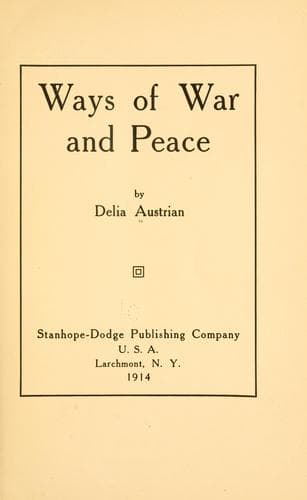
Peace; World War, 1914-1918 -- Personal narratives
I soon saw that it was as difficult to combat the egotistical in peace
as in war, so I decided to sit steady and await an opportunity. The next
morning I went down at six-thirty to see what the fifty thousand guests
were doing and how they took the situation. The place about the
music-stand was packed with Germans and German-Americans who were
listening to such strains as "Der Wacht am Rhein," "Deutchland über
Alles," intermingled with our own "Star Spangled Banner." The only
comment made on these strains were the cries of "Hoch! Hoch!" from time
to time. At the other end of the grounds was another mob of men and
women reading the extra bulletin that a Russian regiment had crossed the
frontier and Germany had declared war. The men had a worried look and
the women were pale and anxious, but all showed magnificent control.
There were no cries heard of "Down with Russia!" or "Down with France!"
Many of these Germans were still filled with hope that Sir Edward Grey
would bring these foreign powers to a satisfactory understanding.
It was not until Tuesday that the first men enlisted and martial law was
proclaimed. A large part of the promenade was roped off and guarded by
petty officers. Nobody crossed this plot of ground under penalty of
being shot.
The proclaiming of martial law was a new experience for me, so I stood
behind the ropes for hours at a time, seeing the young men come to the
front, take the oath and enlist. The first regiments were only boys,
still unmarried, living in romance rather than actuality. But I soon
decided that it was not as hard for them to bid their sweethearts
goodbye as it was a little later for fathers to bid their wives and
several clinging children farewell. A week later it was even harder to
see the old men, many of whom had served in the war of '70 and '71,
gladly come forth again to join the rank and file. More than twenty-five
thousand men enlisted in a week. They ranged from nineteen to forty-five
and came from all conditions of life; the richest and the poorest alike
were eager to go and fight and if necessary to die for their country.
They were impatient to change their civilian uniform for the
earth-color uniforms. It was pathetic to see some of them hand over
their old suits to their wives, for I wondered if they would ever use
them again. But they seemed hopeful as they moved on, singing their
favorite military strains. Each regiment had its favorite song; with one
it was "Der Wacht am Rhein," with another "Deutchland über Alles."
Public-domain text, read in full here on John Shaqi.
Reviews
Reviews
No reviews yet
Be the first to share your thoughts on this work.
Join the Discussion
Join the discussion
Sign in to leave a comment or review.
Sign InorCreate an account