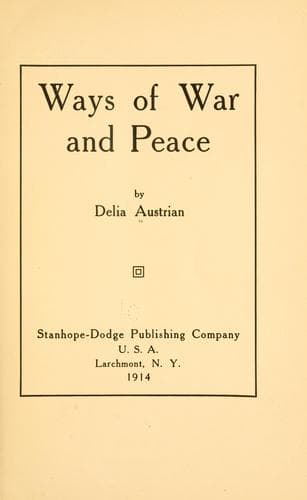
Peace; World War, 1914-1918 -- Personal narratives
The expressions of the people waiting outside seemed to say I care for
nothing save "Home, Sweet Home" or "Take me back to Grigsby's station."
After getting our passports signed we were told to come back next day
for our tickets for the special train. In the meantime we had to turn
over our passports to the German minister of war and get them back at
our own Embassy. The rest of the time was put in visiting a few of the
galleries left open, watching the great crowds of people that surged
around the Emperor's house, trying to get a glimpse of him, and in
trying to get the latest news of war from our own papers. Sunday morning
I went up to the Dom Church, the great church of Berlin, which was
packed to the doors with German men and women bent in solemn prayer. For
the Landsturm had been called out that morning and thousands of men knew
that they would have to be off to the war in the morning. At noon, when
the many church doors were thrown open, thousands of people passed out,
the men with heads uncovered, the women pale and earnest, but all
resigned and willing to do their best. All eyes were bent to the palace,
for the lowered flag showed that the Emperor was at home making his
preparations for leaving that night. This was the first day for a week
that there had been quiet around the palace. Until Sunday thousands of
people were gathered all day long singing the Kaiser's favorite songs
and shouting "Hoch! Hoch!" every time they caught a glimpse of him, and
especially when he ventured out on the balcony to make a speech to his
people. That afternoon hundreds of people gathered with their children
in the Thiergarten to enjoy the animals and to listen to the military
band play many patriotic airs. This was the last peaceful Sunday that
hundreds of husbands spent with their families. Next morning many a
tired woman commenced to work to help the Red Cross, and to put the
different hospitals and royal homes that had been turned into hospitals
ready for the wounded soldiers. The Empress did her share, and the Crown
Princess gave one of her palaces for this work. On every street corner
there were young girls and women hard at work getting contributions for
the Red Cross. Berlin became so deserted of men that it was next to
impossible to find men salesmen in the shops, while they were even
trying the women out as conductors on the street cars. The banks were
more than half emptied of their clerks and the police work was being
done by the older men.
Public-domain text, read in full here on John Shaqi.
Reviews
Reviews
No reviews yet
Be the first to share your thoughts on this work.
Join the Discussion
Join the discussion
Sign in to leave a comment or review.
Sign InorCreate an account