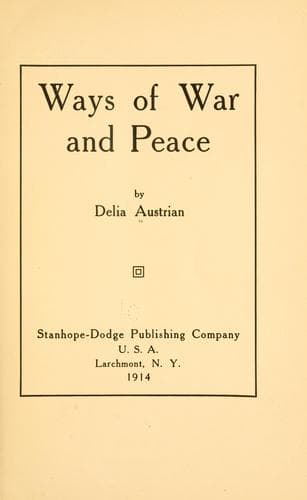
Peace; World War, 1914-1918 -- Personal narratives
This educational campaign was interrupted for a short time when Miss
Eckstein went to take the American petitions to The Hague. She attended
the round-table talks, afternoon teas and receptions, where time and
again she showed that war, besides being futile was the most reckless
extravagance of modern times. The cost of feeding and supporting a
soldier would keep a child in school; the cost of a siege-gun would pay
for the building of a school house, and the building of a battleship
would give a country a new university. She showed them time and again
that besides suffering, war meant the destruction of a nation's best
manhood. It is the strong and energetic and the brilliant minds that are
picked for soldiers. It is the weak and old men along with women and
children that usually survive to suffer the hardships and the heartaches
made possible by war. It was at one of these international receptions
that I had the pleasure of hearing Miss Eckstein express some such
ideas. She spoke of the work of The Hague Tribunal, and had such
confidence in the sincerity of the governments and their representatives
that she thought any question of vital importance might be settled there
rather than that rulers should enchain civilization and throw nations to
the dogs of war.
Later, through a foundation by Mr. Edwin Ginn, the publisher of Boston,
Miss Eckstein went to Europe for the purpose of preaching the gospel of
peace. She talked in schools, theatres and concert halls before large
audiences composed of school teachers, and school children, government
officials and working people. But her chief purpose was to educate the
school children in the larger, more wholesome ideas of peace. Some of
the most spacious and handsomest halls in Germany were put at her
disposal, and some of the most influential German officials presided at
her meetings. She was equally well received, and was welcomed with the
same enthusiasm in France, Italy, England and the North countries. She
hoped to carry this propaganda into Japan, India and Africa. At the same
time she was working to carry a petition of thirty million names, signed
in all parts of Europe and the United States, to The Hague. This
stupendous work was almost finished when the war broke out.
Public-domain text, read in full here on John Shaqi.
Reviews
Reviews
No reviews yet
Be the first to share your thoughts on this work.
Join the Discussion
Join the discussion
Sign in to leave a comment or review.
Sign InorCreate an account