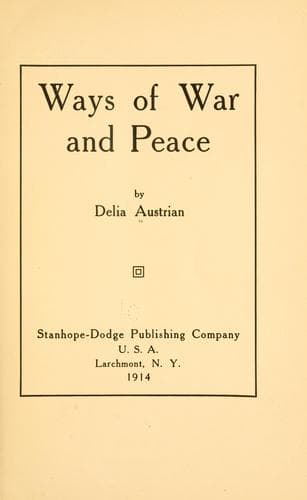
Peace; World War, 1914-1918 -- Personal narratives
Finally we were off, and certainly this midnight ride compares favorably
with Paul Revere's famous ride. I do not know how many kilometers we
covered per hour, but I do know that if anything had bounced against us
or we against anything we would not have lived to tell the tale. We went
through deep woods, dark streets, through small villages and through
long, narrow dams at breakneck speed. We had the right of way except for
the tolls that had to be raised, for the soldiers watching at a distance
and for an occasional drunkard that tumbled into the streets. We went so
fast that every time our automobile took a bridge it flew several feet
into the air. It was only kind Providence watching over us that saved us
from being shot as spies--at least being taken prisoners. It was one
o'clock when we entered the Holland American office and gave up a good
cabin on the Rotterdam for two berths in the auxiliary cabin on the
Ryndam.
As we came on board we saw our ambassador, Mr. Van Dyke, tell some of
his friends goodbye and wish them Godspeed. We stopped to hear some
people exclaim, "My, that was a splendid speech--I guess he is sorry he
is not going home--well, if a man wishes to be an ambassador he must do
his duty and watch his people--I wonder how many of us will take his
advice and keep neutral in thought on this trip." As soon as we got on
board we found that ours was not a choice cabin. It was one of the forty
cabins made in a week in the hold of the boat usually made to keep the
trunks.
I decided not to go to our cabin that night, as it was nearly two
o'clock before the boat pulled out, and then we sat around and chatted
some time about the mines in the channel and the possibility of our boat
striking one and being blown to pieces. When we tired of sitting on deck
we went down into the dining salon and slept on benches in impromptu
manner. To tell the truth of the matter, we were reaching a point where
a few hours seemed a luxurious amount of sleep. Many who did not find
the early morning air too brisk camped out on steamer chairs outside.
Next morning my mother and I went down to see what our cabin was like.
After reaching the lower deck we had to climb down a small ladder to get
to our room. The company had tried to make the hold attractive by
arranging palms and flowers around the walls. The center of the hall was
usurped by trunks, for about one-third of the first-class passengers had
been fortunate enough to save their baggage. Some of the flat trunks
were useful, for they served as chairs and benches when our cabins
became too crowded during the day.
Public-domain text, read in full here on John Shaqi.
Reviews
Reviews
No reviews yet
Be the first to share your thoughts on this work.
Join the Discussion
Join the discussion
Sign in to leave a comment or review.
Sign InorCreate an account