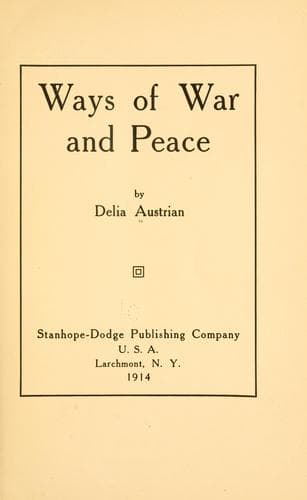
Peace; World War, 1914-1918 -- Personal narratives
There are a number of questions that enter into this war. Foremost among
these is militarism. There is not a country at war today that believes
that a government is made for its people, their theory being that a
people belongs to its government. Therefore it is the interest of the
country, not the interest of the individual, that counts. This idea is
part and parcel of the old feudal form of government, where there were a
few mighty feudal lords and many vassals or dependents. These dependents
lived on the estates of their lords and got their sustenance from them.
In turn they had to swear life and death allegiance to their lords,
fight for them in times of danger, accompany them on crusades and amuse
them in time of peace in jousts and tournaments.
Though feudalism as a form of government is no longer fashionable, it
still survives in spirit. Thousands of men are employed in Europe in
different ways by their governments or by their monarchs, and they are
in honor bound to fight for these kings and princes. In times of danger,
these men are employed on railroads belonging to the government, working
in palaces or on royal estates, or in the army. There are many old towns
in Europe where you see feudal palaces perched on high hills or
overhanging crags. These were protected by drawbridges, moats or great
encircling walls. All that remain of their past glory are the deserted
ruins, mouldered walls and drawbridges, but the spirit of these feudal
rulers still remains. They now live in capitals in the winter and on
lovely estates in the summer. They have from five to twenty estates
apiece. Many of these places are only used a few weeks out of the year.
Their permanent residences are adorned with priceless furniture,
tapestries and ornaments. These are kept up by a retinue of servants,
while even those that are occupied for a short time call for plenty of
care and expense for their maintenance.
Hard though it is to believe, there are palaces that have been twenty
years in the process of building and are still not completed. When a new
monarch comes to the throne it is not unusual to have his palace
refurnished from top to bottom. Entertaining at these courts means a
great expenditure of money, for their china-closets are crowded with
priceless china, finest glass, silver and gold service for all
occasions. Though the menus planned for any of these state affairs are
costly, the great extravagance comes in the fine wine-cellars, rare
fruits, and the hot-house flowers used for decorations. I have walked
over royal estates for a half-day without reaching their limit. The
place included summer houses, pagodas, alleys, private promenades,
stables and carriage-houses.
Public-domain text, read in full here on John Shaqi.
Reviews
Reviews
No reviews yet
Be the first to share your thoughts on this work.
Join the Discussion
Join the discussion
Sign in to leave a comment or review.
Sign InorCreate an account