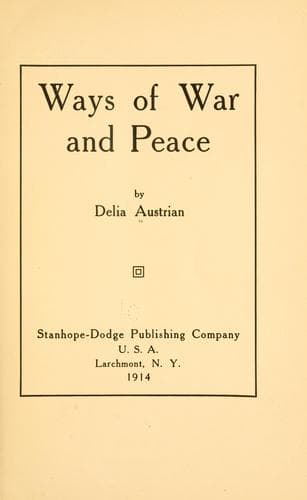
Peace; World War, 1914-1918 -- Personal narratives
army and navy to enforce the decisions agreed upon by the different
nations and their representatives.
There were few men in America who did more for the peace work of this
country than Dr. Edward Everett Hale. As Edwin D. Mead says of him, "He
stood for citizenship, he stood for education, he stood for
international peace and friendship. We called him in the later years of
his life the Nestor of our peace cause in America." He made his church a
temple of that cause. He said there should be no modern church which did
not have among its regular standing committees a committee on
International Justice, and such a committee he founded in this church.
Baroness von Suttner and Baron d'Estournelles de Constant both occupied
his pulpit.
Dr. Hale worked extremely hard to organize a Boston committee on
International Justice.
Dr. Hale and Anna Eckstein were the two fountains of inspiration for
Edwin Ginn, of Boston. Life had taught him that real riches and power
only have value as they work for social uplift. He was sure of this
after he met Miss Eckstein and saw the great work and effort she was
expending to promote ideas of peace in the schools of this country and
abroad. She influenced him to set aside one million dollars; the income
of the money was to be used for this purpose. He was so impressed by her
work that he asked her to give all of her time to educating the teachers
and children in Europe as well as in our country in the ideas of peace.
Dr. Hale was his other great inspiration in all the great peace ideas.
His first address in behalf of the peace cause was made at Mohonk Lake,
at one of the Mohonk Conferences in International Arbitration, and there
his last address was made. His first address was made in 1901, although
Mr. Ginn was present at the Mohonk Conference as a listener in 1897 and
1899. In 1901 he gave his first address, and he confessed that Dr. Hale
had influenced him greatly in this work. In this talk he said that
modern wars are due to mutual distrust on the part of the nations and
great armaments. This distrust can only be removed by education and the
right kind of co-operation. The great menace is the enormous armaments.
The tremendous armies and monstrous navies have become far more a
provocation and danger than a defense. He told the people at the Mohonk
Conference: "We are confronted by the military class, the war power,
with unlimited resources of wealth and men, and we can never overcome
these obstacles except as we perfect a great organization to meet them.
It will not do to leave this work to be done by a few. An adequate
counteracting influence could not be exerted simply by men who could
give to the cause only shreds and patches of their time. We must make
this a well-organized crusade; there must be men devoted to the cause,
as Sumner, Garrison and Phillips were devoted to the cause of
anti-slavery: men who would give all their time to it. And the cause
Public-domain text, read in full here on John Shaqi.
Reviews
Reviews
No reviews yet
Be the first to share your thoughts on this work.
Join the Discussion
Join the discussion
Sign in to leave a comment or review.
Sign InorCreate an account