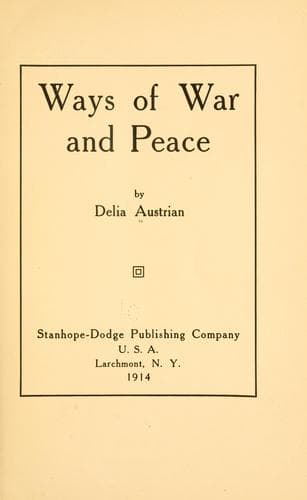
Peace; World War, 1914-1918 -- Personal narratives
The king was supported in his opinion by Walter Asquith, who has been
the firm champion of home rule. He predicted civil war in case the
demands of Ireland were not satisfied, and taunted the government with
pusillanimity in the face of the recent events in South Africa. He then
moved an amendment to the reply to the speech from the throne "that it
would be disastrous for the House to proceed further with the government
for Ireland until the measure had been submitted to the judgment of the
country." He showed his calm judgment and steady hand when the
threatened Ulster uprising took place by proposing home rule for all of
Ireland that wished it.
These radical moves were the more surprising, for King George was spoken
of as a strong conservative when brought to the throne. This was seen by
the patience the Queen and he showed during the coronation in England
and India. They were spoken of as mere figures by the Liberalists
because they went through the endless festivities from the great
procession to the numerous banquets with a smile, with words of patience
and good cheer. It was the first time in many centuries that an English
King and Queen had made a long trip to India to partake in their
coronation festivities at Delhi and Calcutta. They wished to renew the
pledge made by the late Queen Victoria when she assumed the title of
Empress of India, emphasizing the incorporation of the great peninsula
into the British Empire that all her Indian subjects were the children
of the Great White Queen. They showed that this was more than a promise
when they reached Bombay on the 4th of December, 1911. At half-past
nine they and their royal suite drove out to the fête grounds, adjoining
the Bombay Gymkhana building. Here in an open space some 26,000 children
had been drawn up in a large semicircle, over against the centre of
which was a dais for the King and Queen. As their majesties drove up at
a quarter to ten, four selected groups of children belonging to the
European, Urdu, Gujarati and Marathe schools sang each two verses of the
National Anthem in their own tongue. Though they sang in their own
tongue and danced their native dances, they shouted "Long live the King
and Queen" as enthusiastically as would have done the same size body of
English children.
Public-domain text, read in full here on John Shaqi.
Reviews
Reviews
No reviews yet
Be the first to share your thoughts on this work.
Elsewhere in the archive
Join the Discussion
Join the discussion
Sign in to leave a comment or review.
Sign InorCreate an account