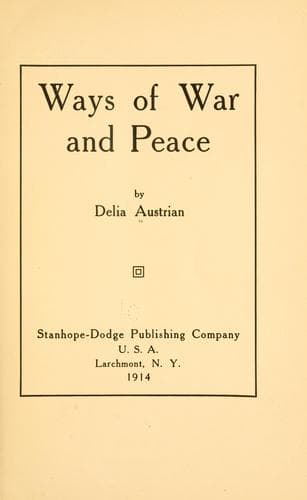
Peace; World War, 1914-1918 -- Personal narratives
The coronation at Delhi took place on the 12th of December. The royal
pavilion was used as a centre of a semicircle, with a radius of about
240 yards erected round the circumference for spectators. All around the
base of the mound ran a processional road, so that their majesties could
drive under the eye of the onlookers. From the southern margin of this
road was erected a huge stand with seating accommodations for ten
thousand spectators. The stand was protected by a steep, sloping roof,
ornamented with Oriental cupolas. The royal pavilion rose from a broad
base in three tiers and ascended by broad stairways to a central
platform surmounted by a huge gilt dome. The royal dais was protected
by a canopy of crimson velvet, trimmed with crimson and gold fringe. At
the royal approach the principal officials and the ruling chiefs took
their places at the base of the stand. They were dressed in their rich
Oriental silks of orange shot with gold or silver ornamented with
armlets of gold, jeweled swords, priceless brooches, orders set with
rubies and emeralds and diamond ornaments fastened in their caps. The
arena was crowded with British and Indian cavalry, handsomely trapped in
gold and red velvet. There was a long procession of English cavalry and
marines, enlarged by a great number of native cavalry. It was shortly
before noon that their majesties appeared at the entrance. The approach
was made known by a salute of 101 guns. They were welcomed by the great
throng present, every one rising to his feet, and they drove round the
grand stand showing themselves to all present. They were welcomed by
great shouts of joy with singing and music, British and Indian airs
intermingling. After their majesties were seated on the throne
surrounded by their suite and attendants, the King rose and announced
the ceremony of his coronation in person to his subjects in India. He
ended his promise of good faith by these words: "To all present,
feudatories and subjects, I tender my loving greetings." Then the
Viceroy came forward and expressed his homage, bowing low thrice as he
approached the throne. He was followed by the ruling chiefs of
Hyderabad, Baroda, Mysore, Kashmer, Rajputana, Central India, etc. These
were led by the Nizam, who were dressed entirely in black, except for
the yellow, mitre-like headdress. After them came the chief justices and
judges of the High Court, the Viceroy's legislative council, the
governors and lieutenant-governors. The ceremony lasted for more than an
hour, and was extremely picturesque. The British officials dressed in
staid blue uniforms made a suitable background for the rich Oriental
costumes and priceless jewels worn by the Indian princes. Their
salutations were no less interesting than their costumes, as they one by
one approached the dais in turn expressing their promise of homage. Some
used the gesture of throwing earth on the head once or oftener; others
simply bowed. The Rajput chiefs almost without exception laid their
Public-domain text, read in full here on John Shaqi.
Reviews
Reviews
No reviews yet
Be the first to share your thoughts on this work.
Elsewhere in the archive
Join the Discussion
Join the discussion
Sign in to leave a comment or review.
Sign InorCreate an account