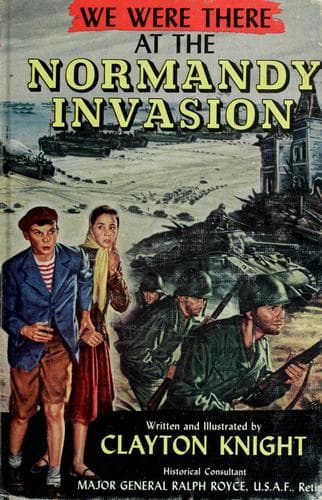
We Were There at the Normandy InvasionKnight, Clayton
History
We Were There at the Normandy Invasion
Knight, Clayton
World War, 1939-1945 -- Juvenile fiction
The man behind the wheel asked, “Is your father here?”
The boy nodded and politely explained, “If you want gas I can work the
pump.”
The driver frowned nervously and repeated, “Get your father.”
From the direction of Ste. Mère Église three German soldiers came
in sight, their heavy tread echoing in the stillness of the drowsy
village. Both men in the car and the boy glanced at them. When the boy
did not move, the driver spoke more sharply, “Your father, bring him
here.”
The boy turned and disappeared through the door.
The driver and his passenger waited. The younger man slid low in his
seat, his back toward the approaching soldiers.
Chatting among themselves, the Germans paid no attention to the car
nor to a girl of fifteen who had come to the house door. Behind her
stood her father, Pierre Gagnon, a burly man with a thick mustache, and
rumpled country clothes.
He brushed past the girl, and at a signal from the driver, went to the
pump. The driver left his seat and bent close to speak to him.
[Illustration: _At a signal from the driver he went to the pump_]
Pierre Gagnon listened carefully, then swung around and went back to
the girl in the doorway.
“Marie,” he whispered, “they want us to hide this fellow, another
downed flyer, for two or three days.”
The girl studied the youth slumped low in the front seat. She thought,
“He looks like all the airmen who are shot down over France--the
worried eyes, the peasant clothes that don’t fit, the bandages.”
“Who is the driver?” she asked. “Has he the right password?”
“Yes,” her father replied. “And he asks us to hide this English pilot
till the Maquis can find a way to get him over the border into Spain.
Do you think we can do it?”
* * * * *
In Normandy, that part of France which thrusts northward into the
English Channel, apple trees were in bloom. Warm, soft breezes played
across the green fields, over the thick hedgerows, and through the
orchards.
But in this beautiful spring of 1944 the people of Normandy could not
enjoy what they saw. They could only hear the tramp of German boots
over their land. Nazi armies had occupied France, and for the last
two years German camps had been set up over the countryside. French
property had been seized, and Nazi officers told the people exactly
what they could and could not do.
The town of Ste. Mère Église sits almost in the middle of what is
called the Cherbourg Peninsula. Most of the Norman people are farmers
or dairymen. Some are fishermen, but the Nazis would not let them fish.
Instead, the Germans set up barriers along the shore to prevent boats
from landing. And they lined the coast with huge guns. Also, the fields
were spiked with posts and barbed wire to keep American and British
gliders from landing.
Public-domain text, read in full here on John Shaqi.
Reviews
Reviews
No reviews yet
Be the first to share your thoughts on this work.
Join the Discussion
Join the discussion
Sign in to leave a comment or review.
Sign InorCreate an account