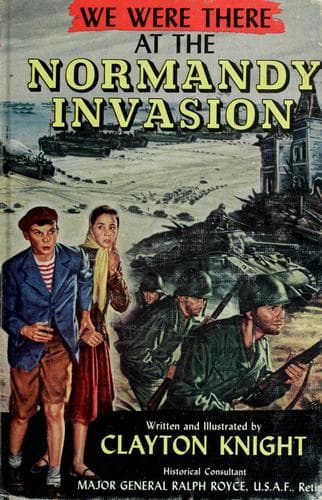
We Were There at the Normandy InvasionKnight, Clayton
History
We Were There at the Normandy Invasion
Knight, Clayton
World War, 1939-1945 -- Juvenile fiction
The men seemed colossal, standing in their turrets before the radio
antennae that wavered nervously, like an insect’s feelers, with the
sway of the tanks. Pushed-up goggles over helmets, and earphones, made
drivers and gunners seem part of the weird contraptions.
“They are wonderful,” André said. “I wish I could have seen them come
ashore from the ships that brought them across the Channel.”
Sergeant Weller frowned. “I don’t think you’d have liked it, son. Only
a few hours ago these men came off landin’ craft that were bein’ shot
at by Nazis from every direction. These guys are just the lucky ones
that didn’t get hit.”
The gathered villagers cheered, and the sound of their welcome rang out
far up the road.
André was still looking for Victor. But Victor had not been seen that
day.
André sauntered over to where the colonel had joined Dobie and the
others in the window.
“Captain,” André began. “Sir, about Victor--”
“I know,” smiled the captain. “You wonder why he doesn’t come back.
I feel sure he’ll be all right. If that car full of Nazi officers
got through the roads from Paris to here, then I’m sure your friend
Victor can find his way around. The Nazi officers said they drove
straight through Caen, Carentan, and right through our lines, if
you please--British _and_ American. They actually got as far as the
Jacquard farm without being detected.”
The colonel spoke up. “As a matter of fact, I don’t think the German
staff in Paris knew how much country our airborne troops were covering.
How could they? We had jammed their coastal radio and radar stations
all the way to Cherbourg. And the French Resistance and our men cut
telephone land lines. So it was impossible for the commanding German
general here on the peninsula to communicate with Paris.”
“Those Nazi prisoners,” said Dobie, “told us they came up from Paris
to find out what was really happening here. Hitler believed that our
invasion was coming at Calais.”
“He sure missed the boat,” Weller said cheerfully.
The last of the squadron of tanks had gone by, and the village people
were returning to their homes. André went back to the farmyard. It was
time for chores. He heard laughter coming from the barns, but by now he
was used to soldier sounds.
First, he must see how badly the orchard and fields in the rear had
been hit by the shelling. He went through the gate in the courtyard
wall.
His jaw dropped. Many apple trees were down. Great smudged shell holes
gaped between them. And the greatest hole yawned only a few feet away
from the edge of the lane where his trumpet was buried.
He snatched up a shovel, and sighed in relief when the trumpet came
up, green and smeared with damp earth, but unharmed. He nestled it
comfortably under his arm and went to the barn door.
The cows had not lowed, and now he saw why. Balanced on stools beside
the animals sat two lusty Americans. They were happily squirting
streams into milk pails held correctly between their knees.
Public-domain text, read in full here on John Shaqi.
Reviews
Reviews
No reviews yet
Be the first to share your thoughts on this work.
Join the Discussion
Join the discussion
Sign in to leave a comment or review.
Sign InorCreate an account