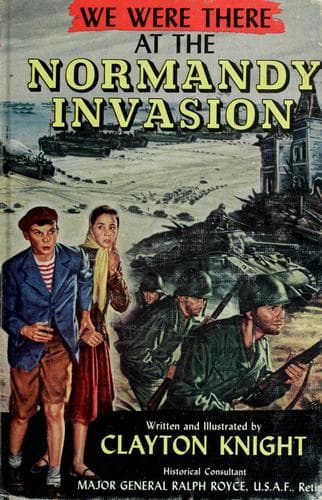
We Were There at the Normandy InvasionKnight, Clayton
History
We Were There at the Normandy Invasion
Knight, Clayton
World War, 1939-1945 -- Juvenile fiction
An American soldier, his shoulders sagging with fatigue, came out of
the underbrush. He frowned at the group. “What’re you folks doing out
here?” he demanded. “You better come along with me.”
The doctor--the only one of the Normans who understood English--said,
“Yes. Most certainly we do not wish to stay here.”
The American started down the slope. Mme. Gagnon and Pierre, attended
by the two other men, followed.
“But Pierre,” Mme. Gagnon protested, “why do we follow them? Did
Patchou come this way?”
Patchou answered this by tearing ahead with great purpose.
“You see,” said Pierre.
At the foot of the slope the American pushed his way through a break in
the hawthornes. At his heels, M. Angell and the doctor gallantly pulled
the bushes apart for Mme. Gagnon.
She took a step forward and stood still, a hand clasped to her heart.
Not twenty feet away, standing near a jeep and a cluster of soldiers,
were André and Marie.
At the same instant André and Marie saw her. And André hurled himself
toward his mother.
“I knew I would find you!” he cried. “I _knew_!”
Marie and Pierre drew into the family embrace.
Slim and Weller turned to catch each other’s eye. “The kid done it,”
Weller said.
Slim sighed. “I shore wish I had that trumpet now,” he said. “I feel
awful sentimental.”
Captain Dobie sat back and smoked, watching the happy reunion of the
Gagnon family.
When the doctor and M. Angell left to start up the hill Marie broke
away from the family to run after them.
“Oh, Monsieur Angell,” she called, “I must tell you how sorry I am your
barn was burned. It was so useful to the Maquis. We are grateful to you
for letting us use it.”
“It is nothing,” M. Angell replied courteously. “It was for France.
However, if you will accept advice from a stranger, I suggest that you
now return home with your mother.”
Marie smiled. “I quite agree with you, M’sieur.”
Within a few minutes, trucks and ambulances drew up. The wounded, both
American and German, were cared for and taken away.
[Illustration]
Weller and Captain Dobie resisted the suggestions of the medics to go
back in the ambulance.
“We don’t want no pamperin’,” Weller said shortly. “I’m only nicked,
anyway.”
The fighting squads clambered aboard trucks to return to the St.
Sauveur front.
The captain leaned from the jeep to talk more easily with Mme. Gagnon
and Pierre.
The radio in the car squawked insistently.
“Answer that signal, will you, Weller?” Captain Dobie said.
Weller snapped a switch, said, “Okay, Colonel,” and gave his report on
Ouvarski’s rescue.
Then he listened a few minutes and exclaimed, “Yes, Colonel ... I’ll
tell the cap’n. Sure will.”
Captain Dobie had stopped talking to listen to Weller.
André asked curiously, “Good news?”
Weller almost shouted, “Our armies are cleanin’ up St. Sauveur, and the
47th’re movin’ on past--headin’ for the coast an’ then Cherbourg.”
“Good,” said Dobie. “Is that all?”
Public-domain text, read in full here on John Shaqi.
Reviews
Reviews
No reviews yet
Be the first to share your thoughts on this work.
Join the Discussion
Join the discussion
Sign in to leave a comment or review.
Sign InorCreate an account