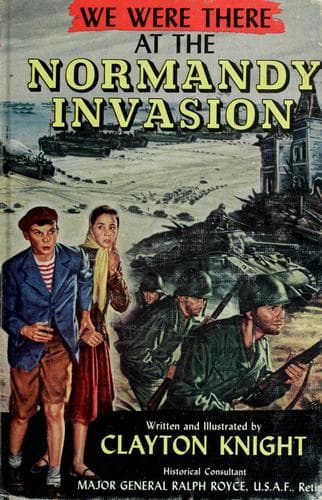
We Were There at the Normandy InvasionKnight, Clayton
History
We Were There at the Normandy Invasion
Knight, Clayton
World War, 1939-1945 -- Juvenile fiction
A few minutes later the house was dark. Everywhere, from the kitchen
where André snuggled into his goosedown-soft, curtained bed, to the
attic, there was the sound of quiet breathing. And in the attic the
English boy turned restlessly on his narrow cot.
Before dawn the household roused to the day’s duties. It was not long
before they heard news. The weary, older German soldiers were being
removed. War-toughened young Nazis were going to take over the district.
Before the new troops had been in camp two days, proclamations that put
stricter limits on freedom were posted everywhere.
A curfew was ordered. People must not leave their houses between ten in
the evening and five in the morning. This did not bother André since he
usually went to bed well before ten.
A sad little good-by note from Papa Schmidt reached him. It thanked the
family warmly for their kindness and ended: “Be a goot boy. Someday I
bring my Otto to see you. _Auf Wiederzehen._”
André noticed that the German camp was a changed place. The new
regiment had chained vicious police dogs inside the wire fence. And
André was horrified when he heard that stray dogs belonging to the
village people had been shot.
He tied Patchou safely in the farmyard at the rear of the house, and
kept an eye on him.
Then came another dreaded order:
ALL ARTICLES OF BRASS OR COPPER MUST BE SURRENDERED BY THE CIVILIAN
POPULATION. A HOUSE-TO-HOUSE SEARCH WILL BE MADE.
André’s most prized possession was a gleaming brass trumpet which he
had learned to play with some skill. It was not only dear to him, but
the only really precious thing he owned. “I must hide it in some very,
very safe place,” he thought.
Also, the coming search would be very dangerous to the rest of the
family. If the Germans came they would surely find the flyer in their
attic. And if an enemy pilot were found in their house they would all
be shot.
Marie and her father had been watching for the Maquis operator to come
for the flyer, according to plan. But for some reason he had not yet
appeared.
“Those Maquis! They are wasting their time in some café, enjoying
themselves, probably,” Mme. Gagnon said irritably.
But Pierre replied, “No. Not the Maquis. There is some good reason why
the operator has not yet been able to get here.”
It was not until June 4th, just before curfew time, that a Maquis
messenger slipped into the Gagnon house.
He said he could not come before because the new Nazi garrison had sent
patrols everywhere.
The plans of the Underground had all been changed. Pierre and Marie, he
said, must keep the flyer where he was until new arrangements to spirit
him away could be made.
That evening Marie and her father huddled in the dark little parlor to
talk over their situation.
Marie whispered wildly, “What _shall_ we do if the Nazis come here?
They will go to the attic too.”
Pierre shrugged, scowling. “We must find some way. We always have
before.”
Public-domain text, read in full here on John Shaqi.
Reviews
Reviews
No reviews yet
Be the first to share your thoughts on this work.
Join the Discussion
Join the discussion
Sign in to leave a comment or review.
Sign InorCreate an account