Negative evidence, or lack of positive statement, should not be forced,
but since it has been employed to prove the formation of a church here
at a given date, perhaps we may be permitted to urge it a little more
strongly in favor of an earlier date for the same event. If there
were, as is admitted, ten other churches in existence on the shores of
the Bay at the arrival of the Hull company in 1635, and that company
proceeded immediately to form the eleventh, in accordance with the
universal custom, several of the preceding ten must have been called
to assist in its organization, in which case we can hardly conceive
it possible that some one at least of the number should not have made
the transaction a matter of record, or that their records should not
in some way allude to it, for the formation of a new church was then a
matter of some importance, but nowhere, in church or state or private
records, do we find the slightest intimation of such an event; whereas,
had there been a church formed at an earlier date, when there was no
other existing on the shores of New England, besides that at Plymouth,
and that not in sympathy, we have a very good reason why we hear
nothing of it.
The material needs of the new settlement and other causes before
alluded to might prevent its own record, while the distractions
afterwards existing, and the consequent jealousies between the
contending parties might easily forbid any subsequent one. The theory
of a regular succession of pastors beginning with Mr. Hull in 1635,
and following down through Mr. Jenner, Mr. Lenthal and Mr. Newman,
until Mr. Thacher is reached, has been a favorite one, but is hardly
admissible in face of the evidence already produced, which would rather
go to show the attempted formation of a second church by some of the
conflicting interests in opposition to one already in existence. We may
hope at some time to discover further testimony with which to settle
this vexed question, but for the present we must be content to allow it
to rest upon no firmer basis than probability, yet with that strongly
in favor of a much earlier organization of the church, reaching back
perhaps to 1623.
FOOTNOTES:
[99] The Old North Church of Weymouth was organized Jan. 30, 1638/9.
The diary of the Rev. Peter Hobart, the minister at Hingham, Mass.,
from 1635 to 1679, reads: “Jan. 30, 1639, [N. S.] A church gathered
at Weymouth.” (From a paper on “The Organization of the Old North
Church of Weymouth,” read before the Weymouth Historical Society, Feb.
24, 1904, by George W. Chamberlain, and published in the _Weymouth
Gazette_, March 18, following.)
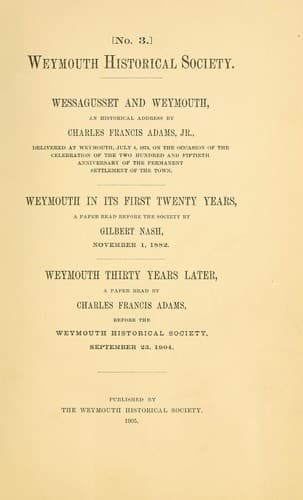
WEYMOUTH THIRTY YEARS LATER
A PAPER READ BY
CHARLES FRANCIS ADAMS
BEFORE THE WEYMOUTH HISTORICAL SOCIETY, AT THE FOGG OPERA HOUSE, SOUTH
WEYMOUTH, ON THE EVENING OF TUESDAY, THE 23D SEPTEMBER, 1904.
Public-domain text, read in full here on John Shaqi.
Reviews
Reviews
No reviews yet
Be the first to share your thoughts on this work.
Elsewhere in the archive
Join the Discussion
Join the discussion
Sign in to leave a comment or review.
Sign InorCreate an account