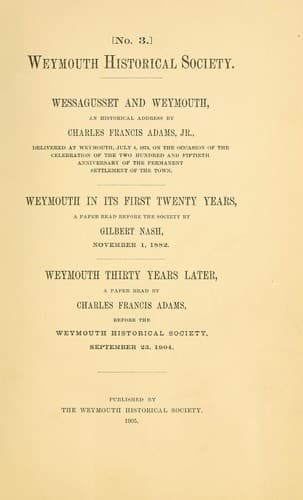
It is already five months since your Society celebrated the completion
of its twenty-fifth year. It may be said to have then attained its
majority. Yet, perhaps, this middle period of September is more
appropriate for your anniversary than a day in April; for towards the
middle of September, 1623, that is, two hundred and eighty-one years
ago at this time,--possibly on what was then the thirteenth of the
month, now the twenty-third,--Captain Robert Gorges, at the head of
a little company of adventurers, sat down at Wessagusset. Thus, as
nearly as can now be ascertained, the permanent settlement of a part
of what has for hard upon two whole centuries and three-quarters of
another been known as Weymouth,--the second permanent settlement in
Massachusetts,--dates from this season, and, possibly, from this day
of September. The Weymouth Historical Society commemorates the event
to-night. It might well commemorate it annually.
But, in the first place, I crave indulgence while I say a single
word personal to myself. I want to explain why I meant to be here
last April, and why I am here now. Towards Weymouth, I confess to a
peculiarly kindly feeling. Not only was Weymouth the birthplace and
maiden home of one whom, among my ancestors, I specially reverence, but
to Weymouth I feel under personal obligation. It is a short story, soon
told; it relates also wholly to myself, but here I feel at liberty to
tell it.
Just thirty years ago last spring, on a day in April, if my memory
serves me right, your old-time selectman, James Humphrey,--remembered
by you as “Judge” Humphrey,--called at my office, then in Pemberton
Square, Boston. Taking a chair by my desk, he next occasioned wide-eyed
surprise on my part by inviting me, on behalf of a committee of the
town of Weymouth, to deliver an historical address at the coming
250th anniversary of the permanent settlement of the place. Recently
returned to civil life from four years of active military service, and
nominally a lawyer, I was at that time chairman of the State Board
of Railroad Commissioners, and, as such, devoting my attention to
questions connected with the growth and development of transportation.
To independent historical investigation I had never given a thought. As
to Weymouth, I very honestly confess I hardly knew where the town so
called was, much less anything of its story; having a somewhat vague
impression only that my great-grandmother, Parson William Smith’s
daughter, Abigail, had been born there, and there lived her girlhood.
Such was my surprise, I remember, that I suggested to Mr. Humphrey
he must be acting under a misapprehension, intending to invite some
other member of my family, possibly my father. He, however, at once
assured me such was not the case, satisfying me finally that, a man
sober and in his right mind, he knew what he was about, and who he
was talking to. Subsequently, I learned that he did indeed act as the
Public-domain text, read in full here on John Shaqi.
Reviews
Reviews
No reviews yet
Be the first to share your thoughts on this work.
Elsewhere in the archive
Join the Discussion
Join the discussion
Sign in to leave a comment or review.
Sign InorCreate an account