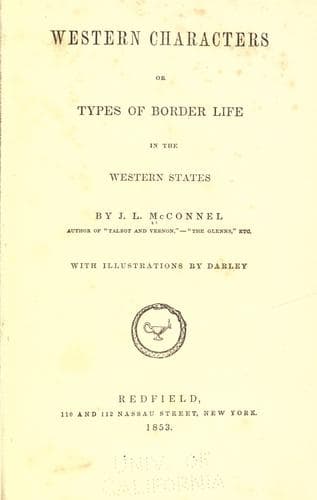
Western Characters; or, Types of Border Life in the Western StatesMcConnel, John Ludlum
General
Western Characters; or, Types of Border Life in the Western States
McConnel, John Ludlum
Frontier and pioneer life -- Mississippi River Valley; Mississippi River Valley -- Social life and customs
One of the characteristics of the early justice, then, was a supreme
contempt for all mere form. He called it "nonsense" and could never
comprehend its utility. To him, all ceremony was affectation, and the
refinements of legal proceeding were, in his estimation, anti-republican
innovations upon the original simplicity of mankind. Technicalities he
considered merely the complicated inventions of lawyers, to exhibit
their perverse ingenuity--traps to catch the well-meaning or unwary, or
avenues of escape for the guilty. The rules of evidence he neither
understood nor cared for; he desired "to hear all about" every cause
brought before him; and the idea of excluding testimony, in obedience to
any rule, he would never entertain. He acted upon the principle--though
he probably never heard of the maxim--that "the law furnishes a remedy
for every wrong;" and, if he knew of none in positive enactment, he
would provide one, from the arsenal of his own sense of right. He never
permitted anything to obstruct the punishment of one whom he had
adjudged guilty; and, rather than allow a culprit to escape, he would
order his judgment to be carried at once into effect, in the presence,
and under the direction of the court.
He had a strong prejudice against every man accused of crime; and
sometimes almost reversed the ancient presumption of the law, and held
the prisoner guilty, until he proved himself innocent. He had unbounded
confidence in the honesty of his neighbors and friends, and was
unwilling to believe, that they would accuse a man of crime or
misdemeanor, without very good cause. When it was proven that a crime
_had been committed_, he considered the guilt of the prisoner already
half established: it was, in his judgment, what one, better acquainted
with legal terms, might have called "a _prima facia_ case," devolving
the _onus probandi_ (or burthen of proof) upon the accused. And this may
have been one cause of the frequent resort to _alibis_--a mode of
defence which, as we have already remarked, is even yet in great
disrepute. If a defence, of some sort, was not, then, very clearly and
satisfactorily made out, the justice had no hesitation in entering
judgment, and ordering immediate punishment; for the right of appeal was
not generally recognised, and the justice took original and final
jurisdiction, where now his duties are merely those of preliminary
examination and commitment.
Public-domain text, read in full here on John Shaqi.
Reviews
Reviews
No reviews yet
Be the first to share your thoughts on this work.
Elsewhere in the archive
Join the Discussion
Join the discussion
Sign in to leave a comment or review.
Sign InorCreate an account