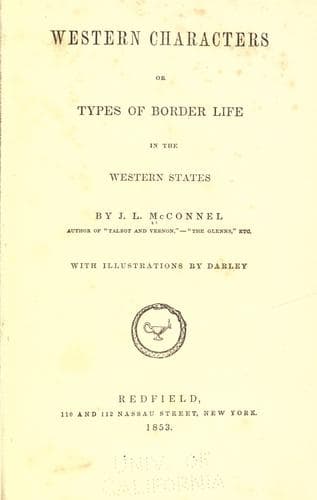
Western Characters; or, Types of Border Life in the Western StatesMcConnel, John Ludlum
General
Western Characters; or, Types of Border Life in the Western States
McConnel, John Ludlum
Frontier and pioneer life -- Mississippi River Valley; Mississippi River Valley -- Social life and customs
In civil controversies--where such causes were presented for
adjudication, which, however, was not very often--the order of
proceeding was quite as summary. The justice heard the statements of the
parties, and sometimes, not always, would listen to witnesses, also;
then, taking the general "rights, interests, claims, and demands," of
both sides into consideration--and viewing himself, not as a judicial
officer, but as a sort of referee or arbitrator--he would strike a
balance between the disputants, and dismiss them to their homes, with a
significant admonition to "keep the peace." He usually acted upon the
principle--no very erroneous one, either--that, when two respectable men
resort to the law, as arbitrator of their controversies, they are both
about equally blamable; and his judgments were accordingly based upon
the corollary, that neither deserved to have all he claimed. This was
the practice when any decision was made at all; but, in most cases, the
justice acted as a pacificator, and, by his authority and persuasion,
induced the parties to agree upon a compromise. For this purpose, he not
unfrequently remitted both fees and costs--those due to the constables,
as well as his own.
An instance of this pacific practice has been related to me as follows:
Two neighbors had quarrelled about a small amount of debt, and, after
sundry attempts to "settle," finally went to law. The justice took them
aside, on the day of trial, and proposed a basis of settlement, to which
they agreed, _on condition_, that all costs should be remitted, and to
this the magistrate at once pledged himself. But a difficulty arose: the
constable, who had not been consulted in the arrangement, had had a long
ride after the defendant, and having an unquestionable right to demand
his fees, was unwilling to give them up. The justice endeavored to
prevail with him by persuasion, but in vain. Finally, growing impatient
of his obstinacy, he gave him a _peremptory order_ to consent, and, on
his refusal, _fined him_ the exact amount of his fees _for contempt_,
entered up judgment on the basis of the compromise, and adjourned the
court!
The man who thus discourages litigation at the expense of his own
official emoluments, may be forgiven a few irregularities of proceeding,
in consideration of the good he effects; for although under such a
system it was seldom that either party obtained his full and just
rights, both were always benefited by the spirit of peace infused into
the community. It would, perhaps, be well for the country now, were our
legal officers actuated by the same motives; unfortunately, however,
such men belong only to primitive times.
Public-domain text, read in full here on John Shaqi.
Reviews
Reviews
No reviews yet
Be the first to share your thoughts on this work.
Elsewhere in the archive
Join the Discussion
Join the discussion
Sign in to leave a comment or review.
Sign InorCreate an account