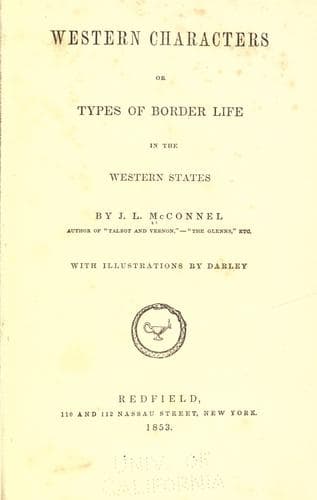
Western Characters; or, Types of Border Life in the Western StatesMcConnel, John Ludlum
General
Western Characters; or, Types of Border Life in the Western States
McConnel, John Ludlum
Frontier and pioneer life -- Mississippi River Valley; Mississippi River Valley -- Social life and customs
But it was not only in the victualing department that the progress of
refinement could be traced; for the thrifty housewife, who thought it
proper to adorn her table, and equip her kitchen with all the late
improvements, could not, of course, entirely overlook "the fashions:"
the decoration of her person has been, in all ages, the just and honest
pride of woman. Linsey-wolsey began to give place to calicoes and
many-colored prints; calf-skin shoes were antiquated by the use of kid;
and ribands fluttered gracefully upon new-fashioned bonnets. Progress of
this kind never takes a step backward: once possessed of an improvement
in personal comfort, convenience, or adornment, man--or woman--seldom
gives it up. Thus, these things, once used, thenceforth became wants,
whose gratification was not to be foregone: and it is one of the
principles governing commerce, that the demand draws to it the supply.
There were few "country stores," in those days, and the settlements were
so scattered as to make it sometimes very inconvenient to visit them.
From ten to twenty miles was a moderate distance to the depot of
supplies; and a whole day was usually consumed in going and returning.
The visits were, therefore, not very frequent--the purchases for many
weeks--perhaps months--being made on each occasion. This was a very
inconvenient mode of "shopping," even for the energetic women of that
day; and, since the population would not justify more numerous
"stores," it was desirable that some new system should be introduced,
capable of supplying the demand at the cost of less trouble, and fewer
miles of travel. To answer this necessity there was but one way--the
"storekeeper" must carry his wares to the doors of his customers. And
thus arose the occupation of the _Peddler_, or, as he called himself,
the "travelling merchant."
The population of the country was then almost exclusively
agricultural--the mechanic arts belong to a more advanced period. The
consequence was, that the first articles carried about from house to
house, were such as are manufactured by artisans--and the chief of these
was tin-ware.
The tinkers of the rural districts in older countries, were, however,
not known in this--they were not adapted to the genius of the people.
The men who sold the ware were, scarcely ever, the same who made it;
and, though the manual dexterity of most of these ready men, might
enable them to mend a broken pan, or a leaky coffeepot, their skill was
seldom put in requisition. Besides, since the mending of an old article
might interfere with the sale of a new one, inability to perform the
office was more frequently assumed than felt.
Public-domain text, read in full here on John Shaqi.
Reviews
Reviews
No reviews yet
Be the first to share your thoughts on this work.
Elsewhere in the archive
Join the Discussion
Join the discussion
Sign in to leave a comment or review.
Sign InorCreate an account