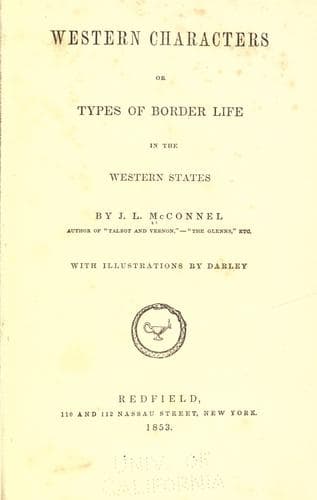
Western Characters; or, Types of Border Life in the Western StatesMcConnel, John Ludlum
General
Western Characters; or, Types of Border Life in the Western States
McConnel, John Ludlum
Frontier and pioneer life -- Mississippi River Valley; Mississippi River Valley -- Social life and customs
In the course of time--as the people of the country began to acquire new
ideas, and discover new wants--other articles were added to the
peddler's stock. Calicoes were often carried in the same box with tin
pans--cotton checks and ginghams were stowed away beneath tin-cups and
iron-spoons--shining coffee-pots were crammed with spools of thread,
papers of pins, cards of horn-buttons, and cakes of shaving-soap--and
bolts of gaudy riband could be drawn from pepper-boxes and
sausage-stuffers. Table-cloths, of cotton or brown linen, were displayed
before admiring eyes, which had turned away from all the brightness of
new tin plates; and knives and forks, all "warranted pure steel,"
appealed to tastes, which nothing else could excite. New razors touched
the men "in tender places," while shining scissors clipped the purses of
the women. Silk handkerchiefs and "fancy" neckcloths--things till then
unknown--could occupy the former, while the latter covetously turned
over and examined bright ribands and fresh cotton hose. The peddler was
a master of the art of pleasing all tastes: even the children were not
forgotten; for there were whips and jew's-harps for the boys, and nice
check aprons for the girls. (The taste for "playing mother" was as much
an instinct, with the female children of that day, as it is in times
more modern; but life was yet too earnest to display it in the dressing
and nursing of waxen babies.) To suit the people from whom the peddler's
income was derived, he must consult at least the appearance of utility,
in every article he offered; for, though no man could do more, to coax
the money out of one's pocket, without leaving an equivalent, even _he_
could not succeed in such an enterprise, against the matter-of-fact
pioneer.
The "travelling merchants" of this country were generally what their
customers called "Yankees"--that is, New-Englanders, or descendants of
the puritans, whether born east of the Hudson or not. And, certainly, no
class of men were ever better fitted for an occupation, than were those
for "peddling." The majority of them were young men, too; for the
"Yankee" who lives beyond middle age, without providing snug quarters
for the decline of life, is usually not even fit for a peddler. But,
though often not advanced in years, they often exhibited qualities,
which one would have expected to find only in men of age and experience.
They could "calculate," with the most absolute certainty, what precise
stage of advancement and cultivation, was necessary to the introduction
of every article of merchandise their stock comprised. Up to a certain
limit, they offered, for example, linen table-cloths: beyond that,
cotton was better and more saleable; in certain settlements, they could
sell numbers of the finer articles, which, in others, hung on their
hands like lead; and they seemed to know, the moment they breathed the
air of a neighborhood, what precise character of goods was most likely
to pay.
Public-domain text, read in full here on John Shaqi.
Reviews
Reviews
No reviews yet
Be the first to share your thoughts on this work.
Elsewhere in the archive
Join the Discussion
Join the discussion
Sign in to leave a comment or review.
Sign InorCreate an account