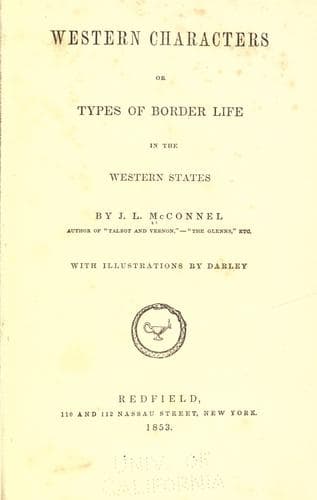
Western Characters; or, Types of Border Life in the Western StatesMcConnel, John Ludlum
General
Western Characters; or, Types of Border Life in the Western States
McConnel, John Ludlum
Frontier and pioneer life -- Mississippi River Valley; Mississippi River Valley -- Social life and customs
His address was extremely insinuating, for he always endeavored to say
the most agreeable things, and no man could judge more accurately what
would best please the person addressed. He might be vain enough, but his
egotism was never obtruded upon others. He might secretly felicitate
himself upon a successful trade, but he never boasted of it. He seemed
to be far more interested in the affairs of others than in his own. He
had sympathy for the afflictions of his customers, counsel for their
difficulties, triumph in their success.
Before the introduction of mails, he was the universal news-carrier, and
could tell all about the movements of the whole world. He could gossip
over his wares with his female customers, till he beguiled them into
endless purchases, for he had heard of every death, marriage, and birth
within fifty miles. He recollected the precise piece of calico from
which Mrs. Jones bought her last new dress, and the identical bolt of
riband from which Mrs. Smith trimmed her "Sunday bonnet." He knew whose
children went to "meeting" in "store-shoes," whose daughter was
beginning to wear long dresses, and whose wife wore cotton hose. He
could ring the changes on the "latest fashions" as glibly as the
skilfulest _modiste_. He was a _connoisseur_ in colors, and learned in
their effects upon complexion. He could laugh the husband into
half-a-dozen shirts, flatter the wife into calico and gingham, and
praise the children till both parents joined in dressing them anew from
top to toe.
He always sold his goods "at a ruinous sacrifice," but he seemed to have
a depot of infinite extent and capacity, from which he annually drew new
supplies. He invariably left a neighborhood the loser by his visit, and
the close of each season found him inconsolable for his "losses." But
the next year he was sure to come back, risen, like the Phoenix, from his
own ashes, and ready to be ruined again--in the same way. He could never
resist the pleading look of a pretty woman, and if she "jewed" him
twenty per cent. (though his profits were only two hundred), the
tenderness of his heart compelled him to yield. What wonder is it, then,
if he was a prime favorite with all the women, or that his advent, to
the children, made a day of jubilee?
But the peddler, like every other human "institution," only had "his
day." The time soon came when he was forced to give way before the march
of newfangledness. The country grew densely populated, neighborhoods
became thicker, and the smoke of one man's chimney could be seen from
another's front-door. People's wants began to be permanent--they were no
longer content with transient or periodical supplies--they demanded
something more constant and regular. From this demand arose the little
neighborhood "stores," established for each settlement at a central and
convenient point--usually at "cross-roads," or next door to the
blacksmith's shop--and these it was which superseded the peddler's
trade.
Public-domain text, read in full here on John Shaqi.
Reviews
Reviews
No reviews yet
Be the first to share your thoughts on this work.
Elsewhere in the archive
Join the Discussion
Join the discussion
Sign in to leave a comment or review.
Sign InorCreate an account