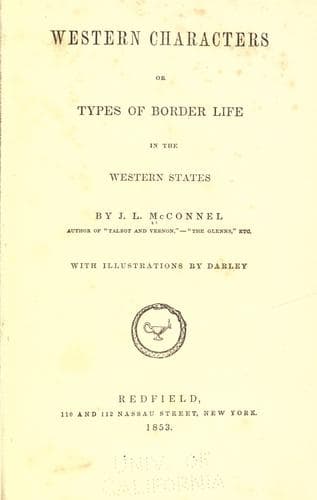
Western Characters; or, Types of Border Life in the Western StatesMcConnel, John Ludlum
General
Western Characters; or, Types of Border Life in the Western States
McConnel, John Ludlum
Frontier and pioneer life -- Mississippi River Valley; Mississippi River Valley -- Social life and customs
He was distinguished by energy as well as shrewdness, and an
enterprising spirit was the first element of his prosperity. There was
no corner--no secluded settlement--no out-of-the way place--where he was
not seen. Bad roads never deterred him: he could drive his horses and
wagon where a four-wheeled vehicle never went before. He understood
bearings and distances as well as a topographical engineer, and would
go, whistling contentedly, across a prairie or through a forest, where
he had not even a "trail" to guide him. He could find fords and
crossings where none were previously known to exist; and his pair of
lean horses, by the skilful management of their driver, would carry him
and his wares across sloughs and swamps, where a steam-engine would have
been clogged by the weight of a baby-wagon. If he broke his harness or
his vehicle in the wilderness, he could repair it without assistance,
for his mechanical accomplishments extended from the shoeing of a horse
to the repair of a watch, and embraced everything between. He was never
taken by surprise--accidents never came unexpected, and strange events
never disconcerted him. He would whistle "Yankee Doodle" while his
horses were floundering in a quagmire, and sing "Hail Columbia" while
plunging into an unknown river!
He never met a stranger, for he was intimately acquainted with a man as
soon as he saw him. Introductions were useless ceremonies to him, for he
cared nothing about names. He called a woman "ma'am" and a man "mister,"
and if he could sell either of them a few goods, he never troubled
himself or them with impertinent inquiries. Sometimes he had a habit of
learning each man's name from his next neighbor, and possessing an
excellent memory, he never lost the information thus acquired.
When he had passed through a settlement once, he had a complete
knowledge of all its circumstances, history, and inhabitants; and, the
next year, if he met a child in the road, he could tell you whom it most
resembled, and to what family it belonged. He recollected all who were
sick on his last visit--what peculiar difficulties each was laboring
under--and was always glad to hear of their convalescence. He gathered
medicinal herbs along the road, and generously presented them to the
housewives where he halted, and he understood perfectly the special
properties of each. He possessed a great store of good advice, suited to
every occasion, and distributed it with the disinterested benevolence of
a philanthropist. He knew precisely what articles of merchandise were
adapted to the taste of each customer; and the comprehensive "rule of
three" would not have enabled him to calculate more nicely the exact
amount of "talk" necessary to convince them of the same.
Public-domain text, read in full here on John Shaqi.
Reviews
Reviews
No reviews yet
Be the first to share your thoughts on this work.
Elsewhere in the archive
Join the Discussion
Join the discussion
Sign in to leave a comment or review.
Sign InorCreate an account