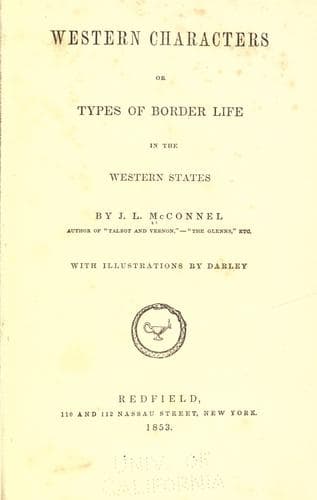
Western Characters; or, Types of Border Life in the Western StatesMcConnel, John Ludlum
General
Western Characters; or, Types of Border Life in the Western States
McConnel, John Ludlum
Frontier and pioneer life -- Mississippi River Valley; Mississippi River Valley -- Social life and customs
Thus: All thinking men will eagerly admit, that the profession of the
schoolmaster is, not only respectable, but honorable, alike to the
individual, and to the community in which he pursues it: yet, rather
than teach a school for a livelihood, the large majority of the same men
would "split rails" or cut cord-wood! And this is not because teaching
is laborious--though it _is_ laborious, and thankless, too, beyond all
other occupations; but because a number and variety of causes, into
which we need not inquire, have combined to throw ridicule upon him, who
is derisively called the pedagogue--for most men would rather be shot
at, than laughed at. Cause and effect are always inter-reactive: and the
refusal of the most competent men, to "take up the birch"--which is the
effect of this derision--has filled our school-rooms with men, who are,
not unfairly, its victims. Thus the profession--(for such is its
inherent dignity)--itself, has fallen into discredit--even though the
judgment of men universally is, that it is not only useful, but
indispensable.
Nor is that judgment incorrect. For, though home-education may sometimes
succeed, it is usually too fragmentary to be beneficial--private tutors
are too often the slaves of their pupils, and can not enforce "attention,"
the first condition of advancement, where they have not the paraphernalia
of command--and, as for self-education, logically there can be no such
thing: "one might as well attempt to lift himself over the fence, by the
straps of his boots," as to educate himself "without a master."
The schoolmaster, then, is a useful member of society--not to be spared
at any stage of its progress. But he is particularly necessary to
communities which are in the transition state; for, upon the
enlightenment of the rising generation depend the success and
preservation of growing institutions. Nor does his usefulness consist
altogether--or even in a great measure--in the number of facts,
sciences, or theories, with which he may store the minds of his pupils.
These are not the objects of education, any more than a knowledge of the
compartments in a printer's "letter-case," is the ultimate result of the
art of printing. The types are so arranged, in order to enable the
compositors more conveniently to attain the ends, for which that
arrangement is only a preparation: facts and sciences are taught for
the improvement of the faculties, in order that they may work with more
ease, force, and certainty, upon other and really important things; for
education is only the marshalling of powers, preliminary to the great
"battle of life."
Public-domain text, read in full here on John Shaqi.
Reviews
Reviews
No reviews yet
Be the first to share your thoughts on this work.
Elsewhere in the archive
Join the Discussion
Join the discussion
Sign in to leave a comment or review.
Sign InorCreate an account