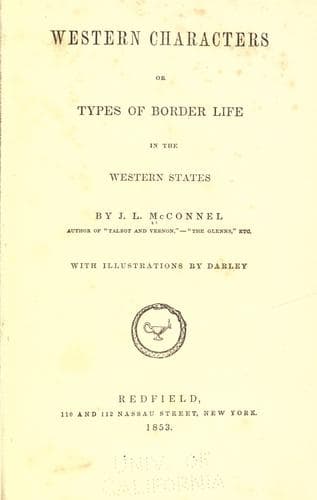
Western Characters; or, Types of Border Life in the Western StatesMcConnel, John Ludlum
General
Western Characters; or, Types of Border Life in the Western States
McConnel, John Ludlum
Frontier and pioneer life -- Mississippi River Valley; Mississippi River Valley -- Social life and customs
The mind of an uneducated man, however strong in itself, is like an army
of undisciplined men--a crowd of chaotic, shapeless, and often
misdirected elements. To bring these into proper subjection--to enable
him to bind them, with anything like their native force, to a given
purpose--a prescribed "training" is necessary; and it is this which
education supplies. If you can give a mind the _habit of attention_, all
the power it has will be made available: and it is through this faculty,
that even dull minds are so frequently able to mount the car of triumph,
and ride swiftly past so many, who are immeasurably their superiors. The
first element of the discipline which develops this power, is submission
to control; and without such subordination, a school can not exist.
Thus, the first lesson that children learn from the schoolmaster, is the
most valuable acquisition they can make.
But it was no easy task to teach this principle to the sturdy children
of the early Western "settler;" in this, as in all other things, the
difficulty of the labor was in exact proportion to its necessity. The
peculiarities of the people, and the state of the country, were not
favorable to the establishment of the limited monarchy, requisite to
successful teaching. In the first place, the parents very generally
undervalued, what they called "mere book-learning." For themselves, they
had found more use for a rifle than a pen; and they naturally thought it
a much more valuable accomplishment, to be able to scalp a squirrel with
a bullet, at a hundred paces, than to read the natural history of the
animal in the "picture-book." They were enthusiastic, also, upon the
subject of independence; and, though they could control their children
sternly enough at home, they were apt to look, with a jealous eye, upon
any attempt to establish dominion elsewhere. The children partook
largely of the free, wild spirit of their fathers. They were very prompt
to resist anything like encroachment upon their privileges or rights,
and were, of course, pretty certain to consider even salutary control an
attempt to assert a despotism. I believe history contains no record,
whatever the annals of fiction may display, of a boy, with much spirit,
submitting without a murmur to the authority of the schoolmaster: if
such a prodigy of enlightened humility ever existed, he certainly did
not live in the west. But a more important difficulty than either of
these, was the almost entire want of money in the country; and without
this there was but little encouragement for the effort to overcome other
obstacles. Money _may_ be only a _representative_ of value, but its
absence operates marvellously like the want of the value itself, and the
primitive people of those days, and especially that class to which the
schoolmaster belonged, had a habit, however illogical, of considering it
a desirable commodity, _per se_.
Public-domain text, read in full here on John Shaqi.
Reviews
Reviews
No reviews yet
Be the first to share your thoughts on this work.
Elsewhere in the archive
Join the Discussion
Join the discussion
Sign in to leave a comment or review.
Sign InorCreate an account