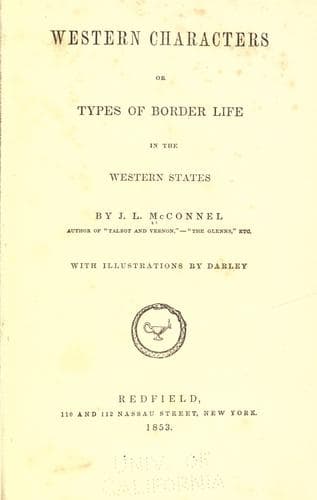
Western Characters; or, Types of Border Life in the Western StatesMcConnel, John Ludlum
General
Western Characters; or, Types of Border Life in the Western States
McConnel, John Ludlum
Frontier and pioneer life -- Mississippi River Valley; Mississippi River Valley -- Social life and customs
But he possessed other accomplishments beside those of the polemic. He
was not, it is true, overloaded with the learning of "the schools"--was,
in fact, quite ignorant of some of the branches of knowledge which he
imparted to his pupils: yet this was never allowed to become apparent,
for as we have intimated, he would frequently himself acquire, at night,
the lessons which he was to teach on the morrow. But time was seldom
wasted among the people from whom he sprang, and this want of
preparation denoted that his leisure hours had been occupied in
possessing himself of other acquirements. Among these, the most elegant,
if not the most useful, was music, and his favorite instrument was the
flute.
In "David Copperfield," Dickens describes a certain flute-playing tutor,
by the name of Mell, concerning whom, and the rest of mankind, he
expresses the rash opinion, "after many years of reflection," that
"nobody ever could have played worse." But Dickens never saw Strongfaith
Lippincott, the schoolmaster, nor heard his lugubrious flute, and he
therefore knows nothing of the superlative degree of detestable playing.
There _are_ instruments upon which even an unskilful performer may make
tolerable music, but the flute is not one of them--the man who murders
_that_, is a malefactor entitled to no "benefit of clergy:" and our
schoolmaster _did_ murder it in the most inhuman manner! But, let it be
said in mitigation of his offence, he had never received the benefit of
any scientific teaching--he had not been "under the tuition of the
celebrated Signor Wheeziana," nor had he profited by "the invaluable
instructions of the unrivalled Bellowsblauer"--and it is very doubtful
whether he would have gained much advantage from them, had he met the
opportunity.
He knew that, in order to make a noise on the flute, or, indeed,
anywhere else, it was necessary to _blow_, and blow he did, like Boreas!
He always carried the instrument in his pocket, and on being asked to
play--a piece of politeness for which he always looked--he drew it out
with the solemnity of visage with which a tender-hearted sheriff
produces a death-warrant, and while he screwed the joints together,
sighed blasts like a furnace. He usually deposited himself upon the
door-sill--a favorite seat for him--and collecting the younger members
of the family about him, thence poured forth his strains of concentrated
mournfulness.
He invariably selected the most melancholy tunes, playing, with a more
profound solemnity, the gloomiest psalms and lamentations. When he
ventured upon secular music, he never performed anything more lively
than "The Mistletoe Bough," or "Barbara Allen," and into each he threw a
spirit so much more dismal than the original, as almost to induce his
hearers to imitate the example of the disconsolate "Barbara," and "turn
their faces to the wall" in despair of being ever again able to muster a
smile!
Public-domain text, read in full here on John Shaqi.
Reviews
Reviews
No reviews yet
Be the first to share your thoughts on this work.
Elsewhere in the archive
Join the Discussion
Join the discussion
Sign in to leave a comment or review.
Sign InorCreate an account