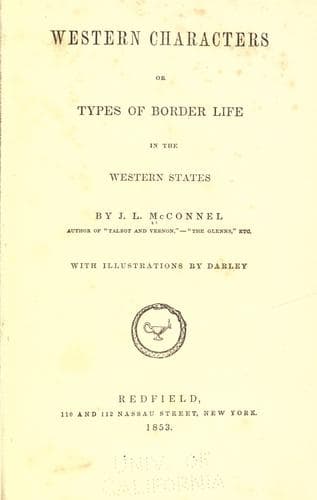
Western Characters; or, Types of Border Life in the Western StatesMcConnel, John Ludlum
General
Western Characters; or, Types of Border Life in the Western States
McConnel, John Ludlum
Frontier and pioneer life -- Mississippi River Valley; Mississippi River Valley -- Social life and customs
He was not a scientific musician, then--fortunately for his
usefulness--because thorough musicians are generally "good-for-nothing"
else. But music was not a science among the pioneers, though the
undertone of melancholy feeling, to which all sweet sounds appeal, was
as easily reached in them as in any other people. Their wants in this,
as in other things, were very easily satisfied--they were susceptible of
pleasure from anything which was in the least commendable: and not
feeling obliged, by any captious canon, to condemn nine true notes,
because of the tenth false one, they allowed themselves to enjoy the
best music they could get, without thinking of the damage done their
musical and critical reputation.
But his flute was not the only means of pleasing within the
schoolmaster's reach: for he could flatter as well as if the souls of
ten courtiers had transmigrated into his single body. He might not do it
quite so gracefully as one of these, nor with phrases so well-chosen, or
so correctly pronounced, but what he said was always cunningly adapted
to the character of the person whom he desired to move. He had "a deal
of candied courtesy," especially for the women; and though his sturdy
manhood and the excellent opinion of himself--both of which came to him
from his ancestry--usually preserved him from the charge of servility,
he was sometimes a "cozener" whose conscience annoyed him with very few
scruples. Occasionally he might be seen fawning upon the rich; but it
was not with him--as it usually is with the parasites of wealthy
men--because he thought Dives more respectable, but more _useful_, on
account of his money: the opulent possessed what the indigent wanted,
and the shortest road to the goal of Cupidity, lay through the region of
Vanity. There was none of that servility which Mr. Carlyle has attempted
to dignify with the name of "hero-worship," for the rich man was rather
a bird to be plucked, than a "hero" to be worshipped. And though it may
seem that I do the schoolmaster little honor by the distinction, I can
not but think cupidity a more manly trait than servility: the beast of
prey a more respectable animal than the hound.
But the schoolmaster's obsequiousness was more in manner than in
inclination, and found its excuse in the dependence of his
circumstances. It has been immemorially the custom of the world,
practically to undervalue his services, and in all time teaching and
poverty have been inseparable companions. Nobody ever cared how poorly
he was clad, how laborious his life, or how few his comforts; and if he
failed to attend to his own interests by all the arts in his power, no
one, certainly, would perform the office for him. He was expected to
make himself generally useful without being particular about his
compensation: he was willing to do the one, but was, very naturally,
rather averse to the other: that which justice would not give him, he
managed to procure by stratagem.
Public-domain text, read in full here on John Shaqi.
Reviews
Reviews
No reviews yet
Be the first to share your thoughts on this work.
Elsewhere in the archive
Join the Discussion
Join the discussion
Sign in to leave a comment or review.
Sign InorCreate an account