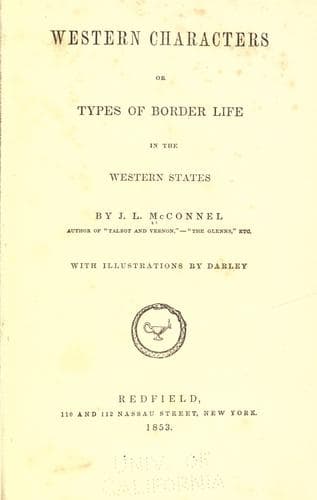
Western Characters; or, Types of Border Life in the Western StatesMcConnel, John Ludlum
General
Western Characters; or, Types of Border Life in the Western States
McConnel, John Ludlum
Frontier and pioneer life -- Mississippi River Valley; Mississippi River Valley -- Social life and customs
His manners thus acquired the characteristics we have enumerated, with
also others. He was, for example, very officious; a peculiarity which
might, perhaps, be derived from his parentage, but which was never
repressed by his occupation. The desire to make himself agreeable, and
his high opinion of his ability to do so, rendered his tone and bearing
very familiar; but this was, also, a trait which he shared with his
race, and one which has contributed, as much as any other, to bring the
people called "Yankees" into contempt in the west. The men of that
section are not themselves reserved, and hate nothing more than
ceremonious politeness: but they like to be the first to make advances,
and their demonstrations are all hearty, blunt, and open. They therefore
disliked anything which has an insinuating tone, and the man who
attempts to ingratiate himself with them, whether it be by elaborate
arts or sidelong familiarity, at once arms them against them.
The schoolmaster was inquisitive, also, and to that western men most
decidedly object. They have little curiosity themselves, and seldom ask
impertinent questions. When they do so, it is almost always for the
purpose of insulting the man to whom they are put, and _never_ to make
themselves agreeable. The habit of asking numerous questions was,
therefore, apt to prejudice them against men whose characteristics might
be, in other respects, very estimable; and it must be acknowledged, that
vulgar and obtrusive impertinence is an unfortunate accompaniment to an
introduction. But the schoolmaster never meant to be impertinent, for
he was far from being quarrelsome (except with his scholars), and the
idea that any one could be otherwise than pleased with his notice,
however given, never entered his mind. Though his questions were, for
the most part, asked to gratify a constitutional curiosity, he was
actuated in some degree, also, by the notion that his condescension
would be acceptably interpreted by those whom he thus favored. But, like
many other benevolent men, who put force upon their inclinations for the
benefit of their neighbors, he was mistaken in his "calculation;" and
where he considered himself a benefactor, he was by others pronounced a
"bore." The fact is, he had some versatility, and, like most men of
various powers, he was prone to think himself a much greater man than he
really was.
Public-domain text, read in full here on John Shaqi.
Reviews
Reviews
No reviews yet
Be the first to share your thoughts on this work.
Elsewhere in the archive
Join the Discussion
Join the discussion
Sign in to leave a comment or review.
Sign InorCreate an account