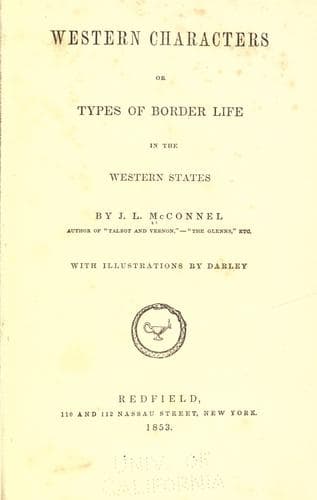
Western Characters; or, Types of Border Life in the Western StatesMcConnel, John Ludlum
General
Western Characters; or, Types of Border Life in the Western States
McConnel, John Ludlum
Frontier and pioneer life -- Mississippi River Valley; Mississippi River Valley -- Social life and customs
New England was the great nursery of this class, as it was of so many
others, transplanted beyond the Alleghenies. Emigration, and the
enticements and casualties of a seafaring life--drawing the men into
their appropriate channels of enterprise and adventure, had there
reduced their number below that of the women--thus remitting many of the
latter, to other than the usual and natural occupations of "the sex."
Matrimony became a remote possibility to large numbers--attention to
household matters gave place to various kinds of light labor--and, since
they were not likely to have progeny of their own to rear, many resorted
to the teaching of children belonging to others. Idleness was a rare
vice; and New England girls--to their honor be it spoken--have seldom
resembled "the lilies of the field," in aught, save the fairness of
their complexions! They have never displayed much squeamishness--about
work: and if they could not benefit the rising generation in a maternal,
were willing to make themselves useful in a tutorial capacity. The
people of that enlightened section, have always possessed the learning
necessary to appreciate, and the philanthropy implied in the wish to
dispel, the benighted ignorance of all other quarters of the world; and
thus a competent number of them have ever been found willing to give up
the comforts of home, for the benefit of the "barbarous west."
The schoolmistress, then, generally came from the "cradle" of
intelligence, as well as "of liberty," beyond the Hudson; and, in the
true spirit of benevolence, she carried her blessings (herself the
greatest) across the mountain barrier, to bestow them, _gratis_, upon
the spiritually and materially needy, in the valley of the Mississippi.
Her vocation, or, as it would now be called, her "mission" was to teach
an impulse not only given by her education, but belonging to her nature.
She had a constitutional tendency toward it--indeed, a genius for it;
like that which impels one to painting, another to sculpture--this to a
learned profession, that to a mechanical trade. And so perfectly was she
adapted to it, that "the ignorant people of the west" not recognising
her "divine appointment," were often at a loss to conjecture, who, or
whether anybody, could have taught _her_!
For that same "ignorant," and too often, ungrateful people, she was full
of tender pity--the yearning of the single-hearted missionary, for the
welfare of his flock. _They_ were steeped in darkness, but _she_ carried
the light--nay, she _was_ the light! and with a benignity, often evinced
by self-sacrifice--she poured it graciously over the land--
"Heaven doth with us, as we with torches do:
Not light them for themselves; for if our virtues
Did not go forth of us, 't were all alike
As if we had them not."
Public-domain text, read in full here on John Shaqi.
Reviews
Reviews
No reviews yet
Be the first to share your thoughts on this work.
Elsewhere in the archive
Join the Discussion
Join the discussion
Sign in to leave a comment or review.
Sign InorCreate an account