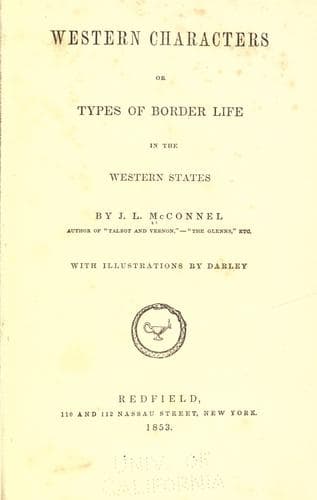
Western Characters; or, Types of Border Life in the Western StatesMcConnel, John Ludlum
General
Western Characters; or, Types of Border Life in the Western States
McConnel, John Ludlum
Frontier and pioneer life -- Mississippi River Valley; Mississippi River Valley -- Social life and customs
For the good of the race, or of any (male) individual, she would
immolate herself, even upon the altar of Hymen; and, since the number,
who were to be benefited by such self-devotement, was small in New
England, but large in the west, she did well to seek a field for her
benign dedication, beyond the Alleghenies! Honor to the all-daring
self-denial, which brought to the forlorn bachelor of the west, a
companion in his labors, a solace in his afflictions, and a mother to
his children!
Her name was invariably Grace, Charity, or Prudence; and, if names had
been always descriptive of the personal qualities of those who bore
them, she would have been entitled to all three.
In the early ages of the world, names were, or, at least, were supposed
to be, fair exponents of the personal characters of those, upon whom
they were bestowed. But, _then_, the qualities must be manifested,
before the name could be earned, so that all who had never distinguished
themselves, in some way, were said to be "nameless." In more modern
times, however, an improvement upon this system was introduced: the
character was anticipated, and parents called their children what they
_wished_ them to be, in the hope that they would grow to the standard
thus imposed. And it is no doubt, true, that names thus bestowed had
much influence in the development of character--on the same principle,
upon which the boards, to which Indian women lash their infants soon
after birth, have much to do with the erect carriage of the mature
savage. Such an appellation is a perpetual memento of parental
counsels--a substitute for barren precept--an endless exhortation to
Grace, Charity, or Prudence.
I do not mean, that calling a boy Cicero will certainly make him an
orator, or that all Jeremiahs are necessarily prophets; nor is it
improbable, that the same peculiarities in the parents, which dictate
these expressive names, may direct the characters of the children, by
controlling their education; but it is unquestionable, that the
characteristics, and even the fortunes of the man, are frequently
daguerreotyped by a name given in infancy. There is not a little wisdom
in the advice of Sterne to godfathers--not "to Nicodemus a man into
nothing."--"Harsh names," says D'Israeli, the elder, "will have, in
spite of all our philosophy, a painful and ludicrous effect on our ears
and our associations; it is vexatious, that the softness of delicious
vowels, or the ruggedness of inexorable consonants, should at all be
connected with a man's happiness, or even have an influence on his
fortune."
"That which we call a rose,
By any other name would smell as sweet;"
Public-domain text, read in full here on John Shaqi.
Reviews
Reviews
No reviews yet
Be the first to share your thoughts on this work.
Elsewhere in the archive
Join the Discussion
Join the discussion
Sign in to leave a comment or review.
Sign InorCreate an account