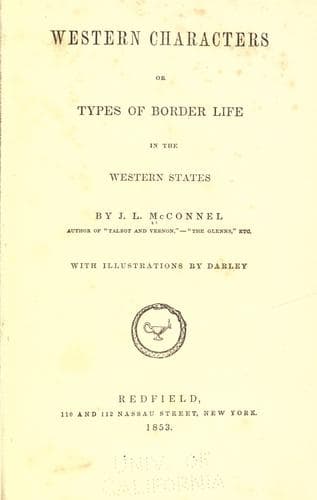
Western Characters; or, Types of Border Life in the Western StatesMcConnel, John Ludlum
General
Western Characters; or, Types of Border Life in the Western States
McConnel, John Ludlum
Frontier and pioneer life -- Mississippi River Valley; Mississippi River Valley -- Social life and customs
Then first began to appear the class of politicians, though, as yet,
office-seeking had not become a trade, nor office-holding a regular
means of livelihood. Politics had not acquired a place among the arts,
nor had its professors become the teachers of the land. There were few,
indeed, who sought to fill civil stations; and, although men's
qualifications for office were, probably, not any more rigidly examined
then than now, those who possessed the due degree of prominence, either
deemed themselves, or were believed by their fellow-citizens, peculiarly
capable of discharging such functions. They were generally men who had
made themselves conspicuous or useful in other capacities--who had
become well or favorably known to their neighbors through their zeal,
courage, sagacity, or public spirit. A leader of regulators, for
example, whose administration of his dangerous powers had been marked by
promptitude and severity, was expected to be equally efficient when
clothed with more regular authority. A captain of rangers, whose
enterprises had been remarkable for certainty and _finish_, would, it
was believed, do quite as good service, in the capacity of a civil
officer. A daring pioneer, whose courage or presence of mind had saved
himself and others from the dangers of the wilderness, was supposed to
be an equally sure guide in the pathless ways of politics. Lawyers were
yet few, and not of much repute, for they were, for the most part,
youthful adventurers, who had come into the field long before the
ripening of the harvest.
There was another class, whose members held prominent positions, though
they had never been distinguished for the possession of any of the
qualifications above enumerated. These might be designated as the
_noisy_ sort--loud-talking, wise-looking men, self-constituted oracles
and advice-givers, with a better opinion of their own wisdom than any
one else was willing to endorse. Such men became "file-leaders," or
"pivot-men," because the taciturn people of the west, though inclined to
undervalue a mere talker, were simple-minded enough to accept a man's
valuation of his own powers: or easy-tempered enough to spare themselves
the trouble of investigating so small a matter. It was of little
consequence to them, whether the candidate was as wise as he desired to
be thought; and since, in political affairs, they knew of no interest
which they could have in disputing it, for _his_ gratification they were
willing to admit it. These were halcyon days for mere pretenders--though
for no very flattering reason: since their claims were allowed chiefly
because they were not deemed worth controverting. Those days, thanks to
the "progress of intelligence!" are now gone by: the people are better
acquainted with the natural history of such animals, and--witness, ye
halls of Congress!--none may now hold office except capable, patriotic,
and disinterested men!
Public-domain text, read in full here on John Shaqi.
Reviews
Reviews
No reviews yet
Be the first to share your thoughts on this work.
Elsewhere in the archive
Join the Discussion
Join the discussion
Sign in to leave a comment or review.
Sign InorCreate an account