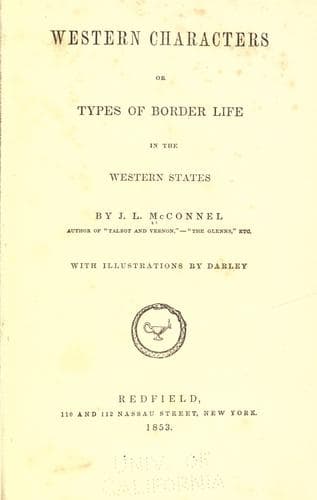
Western Characters; or, Types of Border Life in the Western StatesMcConnel, John Ludlum
General
Western Characters; or, Types of Border Life in the Western States
McConnel, John Ludlum
Frontier and pioneer life -- Mississippi River Valley; Mississippi River Valley -- Social life and customs
Nor must we be understood to assert that the primitive politician was
the reverse of all this, save in the matter of capability. And, even in
that particular, no conception of his deficiency ever glimmered in his
consciousness. His own assumption, and the complaisance of his
fellow-citizens, were inter-reactive, mutually cause and effect. _They_
were willing to confirm his valuation of his own talents: _he_ was
inclined to exalt himself in their good opinion. Parallel to this, also,
was the oracular tone of his speech: the louder he talked, the more
respectfully silent were his auditors; and the more attentive _they_
became, the noisier _he_ grew. Submission always encourages oppression,
and admiration adds fuel to the fire of vanity. Not that the politician
was precisely a despot, even over men's opinions: the application of
that name to him would have been as sore a wound to his self-respect as
the imputation of horse-stealing. He was but an oracle of opinion, and
though allowed to dictate in matters of thought as absolutely as if
backed by brigades of soldiers, he was a sovereign whose power existed
only through the consent of his subjects.
In personal appearance, he was well-calculated to retain the authority
intrusted to him by such men. He was, in fact, an epitome of all the
physical qualities which distinguished the rugged people of the west:
and between these and the moral and intellectual, there is an invariable
correspondence--as if the spirit within had moulded its material
encasement to the planes and angles of its own "form and pressure."
National form and feature are the external marks of national character,
stamped more or less distinctly in different individuals, but, in the
aggregate, perfectly correspondent and commensurate. The man, therefore,
who possesses the national traits of character in their best
development, will be, also, the most faithful representative of his race
in physical characteristics. At some periods, there are whole classes of
these types; and if there be any _one_ who embodies the character more
perfectly than all others, the tranquillity of the age is not calculated
to draw him forth. But in all times of trouble--of revolution or
national ferment--the perfect Man-emblem is seen to rise, and (which is
more to the purpose) is sure to stand at the head of his fellows: for he
who best represents the character of his followers, becomes, by God's
appointment, their leader. To this extent, the _vox populi_ is the _vox
Dei_; and the unfailing success of every such man, throughout his
appointed term, is the best possible justification of the choice.
Public-domain text, read in full here on John Shaqi.
Reviews
Reviews
No reviews yet
Be the first to share your thoughts on this work.
Elsewhere in the archive
Join the Discussion
Join the discussion
Sign in to leave a comment or review.
Sign InorCreate an account