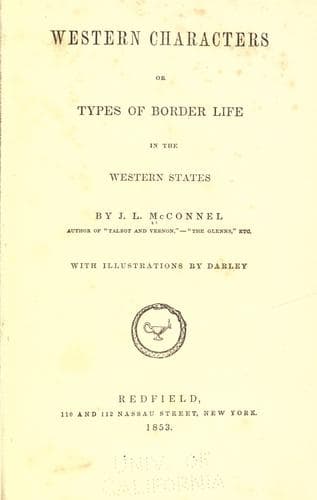
Western Characters; or, Types of Border Life in the Western StatesMcConnel, John Ludlum
General
Western Characters; or, Types of Border Life in the Western States
McConnel, John Ludlum
Frontier and pioneer life -- Mississippi River Valley; Mississippi River Valley -- Social life and customs
What was Washington, for example, but an epitome of the steady and noble
qualities combined of cavalier and puritan, which were then coalescing
in the American character? And what more perfect correspondence could be
conceived between the moral and intellectual and the physical outlines?
What was Cromwell but _the Englishman_, not only of his own time, but of
all times? And the testimony of all who saw him, what is it, but that a
child, who looked upon him, could not fail to see, in his very
lineaments, the great and terrible man he was? And Napoleon, was he
aught but an abridgment of the French nation, the sublimate and "proof"
essence of French character? Not one, of all the great men of history,
has possessed, so far as we know, a physical constitution more perfectly
representing, even in its advancing grossness, both the strength and
weakness of the people he led.
In tranquil times, these things are not observed in one individual more
than in others of his class, and we are, therefore, not prepared to
decide whether, at such periods, _the one man_ exists. The great
Leviathan, the king of all the creatures of the ocean, rises to the
surface only in the tumult of the storm; his huge, portentous form, lies
on the face of the troubled waters only when the currents are changed
and the fountains of the deep are broken up.
Nature does no superfluous work, and it may require the same causes
which produce the storm to organize its Ruler. If a great rebellion is
boiling among men, the mingling of the elements is projecting, also, the
Great Rebel: if a national cause is to be asserted, the principles upon
which it rests will first create its appropriate Exponent. But when no
such agitation is on the point of breaking out--when the crisis is not
near, and the necessity for such greatness distant--national character
probably retains its level; and though there be no _one_ whom the people
will recognise as the arch-man, the representatives, losing in intensity
what they gain in numbers, become a class. They fill the civil stations
of the country, and are known as men of mark--their opinions are
received, their advice accepted, their leading followed. No one of them
is known instinctively, or trusted implicitly, as the leader of Nature's
appointment: yet they are, in fact, the exponents of their time and
race, and in exact proportion to the degree in which they possess the
character, will they exhibit, also, the physical peculiarities.
Thus it was at the time of which we are writing, with the class to which
belonged the politician, and a description of his personal appearance,
like that of any other man, will convey no indistinct impression of his
internal character.
Public-domain text, read in full here on John Shaqi.
Reviews
Reviews
No reviews yet
Be the first to share your thoughts on this work.
Elsewhere in the archive
Join the Discussion
Join the discussion
Sign in to leave a comment or review.
Sign InorCreate an account