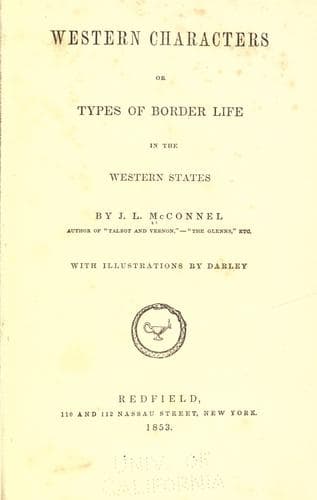
Western Characters; or, Types of Border Life in the Western StatesMcConnel, John Ludlum
General
Western Characters; or, Types of Border Life in the Western States
McConnel, John Ludlum
Frontier and pioneer life -- Mississippi River Valley; Mississippi River Valley -- Social life and customs
From shoulders thus bowed, hung long, muscular arms--sometimes, perhaps,
dangling a little ungracefully, but always under the command of their
owner, and ready for any effort, however violent. These were terminated
by broad, bony hands, which looked like grapnels--their grasp, indeed,
bore no faint resemblance to the hold of those symmetrical instruments.
Large feet, whose toes were usually turned in, like those of the Indian,
were wielded by limbs whose vigor and activity were in keeping with the
figure they supported. Imagine, with these peculiarities, a free, bold,
rather swaggering gait, a swarthy complexion, and conformable features
and tones of voice: and--excepting his costume--you have before your
fancy a complete picture of the early western politician.
But the item of costume is too important to be passed over with a mere
allusion. As well might we paint a mountain without its verdant
clothing, its waving plumes of pine and cedar, as the western man
without his picturesque and characteristic habiliments. The first, and
indispensable article of dress, was the national hunting-shirt: a
garment whose easy fit was well-adapted, both to the character of his
figure and the freedom of his movements. Its nature did not admit much
change in fashion: the only variations of which it was capable, were
those of ornament and color. It might be fringed around the cape and
skirt, or made plain; it might be blue, or copper-colored--perhaps
tinged with a little madder. And the variety of material was quite as
limited, since it must be of either jeans or deer-skin.
Corresponding to this, in material, style, and texture, he wore, also, a
pair of wide pantaloons--not always of precisely the proper length for
the limbs of the wearer, but having invariably a broad waistband, coming
up close under the arms, and answering the purpose of the modern vest.
People were not so dainty about "set" and "fit," in those days, as they
have since become; and these primitive integuments were equally
well-adapted to the figure of any one to whose lot they might fall. In
their production, no one had been concerned save the family of the
wearer. The sheep which bore the wool, belonged to his own flock, and
all the operations, subsequent to the shearing, necessary to the
ultimate result of shaping into a garment, had been performed by his
wife or daughter. Many politicians have continued this affectation of
plainness, even when the necessity has ceased, on account of its effect
upon the masses; for people are apt to entertain the notion, that
decent clothing is incompatible with mental ability, and that he who is
most manifestly behind the improvements of the time, is best qualified
for official stations.
Public-domain text, read in full here on John Shaqi.
Reviews
Reviews
No reviews yet
Be the first to share your thoughts on this work.
Elsewhere in the archive
Join the Discussion
Join the discussion
Sign in to leave a comment or review.
Sign InorCreate an account