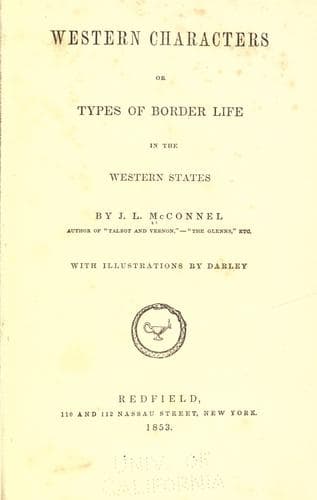
Western Characters; or, Types of Border Life in the Western StatesMcConnel, John Ludlum
General
Western Characters; or, Types of Border Life in the Western States
McConnel, John Ludlum
Frontier and pioneer life -- Mississippi River Valley; Mississippi River Valley -- Social life and customs
A neck-cloth, or cravat, was never seen about the politician's throat;
and for the same reason of expediency: for these were refinements of
affectation which had not then been introduced; and a man who thus
compassed his neck, could no more have been elected to an office, than
if he had worn the cap and bells of a Saxon jester. The shirt-bosoms of
modern days were in the same category; and _starch_ was an article
contraband to the law of public sentiment--insomuch that no epithet
expressed more thorough contempt for a man, than the graphic word
"starched." A raccoon-skin cap--or, as a piece of extravagant finery, a
white-wool hat--with a pair of heavy shoes, not unfrequently without the
luxury of hose--or, if with them, made of blue-woollen yarn, from the
back of a sheep of the aforesaid flock--completed the element of
costume.
He was not very extravagantly dressed, as the reader sees; but we can
say of him--what could not be as truly spoken of many men, or, indeed,
of many women, of this day--that his clothing bore distinct reference to
his character, and was well-adapted to his "style of beauty." In fact,
everything about him, form, face, manners, dress, was in "in keeping"
with his characteristics.
In occupation, he was usually a farmer; for the materials of which
popular tribunes are made in later times--such as lawyers, gentlemen of
leisure, and pugnacious preachers--were not then to be found. The
population of the country was thoroughly agricultural; and though (as I
believe I have elsewhere observed) the rural people of the west were
neither a cheerful nor a polished race, as a class, they possess, even
yet, qualities, which, culminating in an individual, eminently fit him
for the _role_ of a noisy popular leader.
But a man who is merely fitted to such a position, is a very different
animal to one qualified to give laws for the government of the citizen.
After all our vain boasting, that public sentiment is the law of our
land, there is really a very broad distinction between forming men's
opinions and controlling their action. If the government had been so
organized, that the pressure of popular feeling might make itself felt,
directly, in the halls of legislation, our history, instead of being
that of a great and advancing nation, would have been only a chronicle
of factious and unstable violence. It does not follow, that one who is
qualified to lead voters at the polls, or, as they say here, "on the
stump," will be able to embody, in enlightened enactments, the sentiment
which he contributes to form, any more than that the tanner will be able
to shape a well-fitting boot from the leather he prepares. "_Suum cuique
proprium dat Natura donum_."[82] A blacksmith, therefore, is not the
best manufacturer of silver spoons, a lawyer the ablest writer of
sermons, nor either of them necessarily the safest law-maker.
Public-domain text, read in full here on John Shaqi.
Reviews
Reviews
No reviews yet
Be the first to share your thoughts on this work.
Elsewhere in the archive
Join the Discussion
Join the discussion
Sign in to leave a comment or review.
Sign InorCreate an account