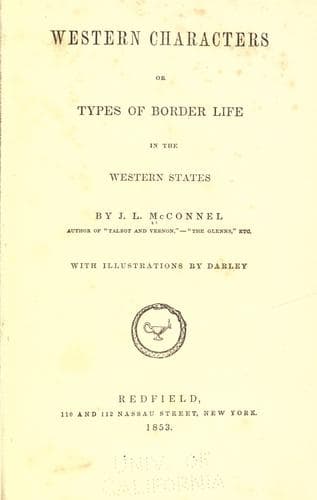
Western Characters; or, Types of Border Life in the Western StatesMcConnel, John Ludlum
General
Western Characters; or, Types of Border Life in the Western States
McConnel, John Ludlum
Frontier and pioneer life -- Mississippi River Valley; Mississippi River Valley -- Social life and customs
"Militia musters" were days in his calendar, "marked with a
white-stone;" for it was upon these occasions that he appeared in his
utmost magnificence. His grade was never lower than that of colonel, and
it not unfrequently extended to, or even beyond, the rank of
brigadier-general. It was worth "a sabbath-day's journey" on foot, to
witness one of these parades; for I believe that all the annals of the
burlesque do not furnish a more amusing caricature of the "pomp and
circumstance" of war. Compared to one of those militia regiments,
Falstaff's famous corps, whose appearance was so unmilitary as to
prevent even that liberal-minded gentleman from marching through
Coventry in their company, was a model of elegance and discipline.
Sedeno's cavalry in the South American wars, though their uniform
consisted only of "leggings," a pair of spurs, and a Spanish blanket,
had more the aspect of a regular _corps d'armee_ than these! A mob of
rustics was never armed with a more extensive variety of weapons; and no
night's "haul" of a recruiting sergeant's net, ever made a more
disorderly appearance, when mustered in the morning for inspection.
The "citizen-soldier" knew no more about "dressing the line," than about
dressing himself, and the front of his company presented as many
inequalities as a "worm-fence." Tall men and short men--beaver hats and
raccoon-skin caps--rusty firelocks and long corn-stalks--stiff brogans
and naked feet--composed the grand display. There were as many officers
as men, and each was continually commanding and instructing his
neighbor, but never thinking of himself. At the command "Right dress!"
(when the officer _par excellence_ knew enough to deliver it) some
looked right, others left--some thrust their heads out before--some
leaned back to get a glimpse behind--and the whole line waved like a
streamer in the wind. "Silence in line!" produced a greater clamor than
ever, for each repeated the command to every other, sending the order
along the ranks like a rolling fire, and not unfrequently enforcing it
with the push of a corn-stalk, or a vigorous elbow-hint. When a movement
was directed, the order reached the men successively, by the same
process of repetition--so that while some files were walking slowly, and
looking back to beckon on their lagging fellow-soldiers, others were
forced to a quick run to regain their places, and the scramble often
continued many minutes after the word "halt!" The longer the parade
lasted, the worse was the drill; and after a tedious day's "muster,"
each man knew less, if possible, of military tactics, than he did in the
morning.
Public-domain text, read in full here on John Shaqi.
Reviews
Reviews
No reviews yet
Be the first to share your thoughts on this work.
Elsewhere in the archive
Join the Discussion
Join the discussion
Sign in to leave a comment or review.
Sign InorCreate an account