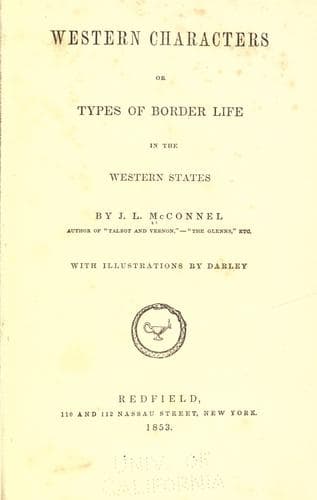
Western Characters; or, Types of Border Life in the Western StatesMcConnel, John Ludlum
General
Western Characters; or, Types of Border Life in the Western States
McConnel, John Ludlum
Frontier and pioneer life -- Mississippi River Valley; Mississippi River Valley -- Social life and customs
But the most ludicrous part of the display, was the earnest solemnity
with which the politician-colonel endeavored "to lick the mass into
shape." If you had judged only by the expression of his face, you would
have supposed that an invading army was already within our borders, and
that this democratic army was the only hope of patriotism to repel the
foreign foe. And, indeed, it might not be too much to say, that some
such idea actually occupied his mind: for he was so fond of "supposing
cases," that bare possibilities sometimes grew in his mind to actual
realities; and it was a part of his creed, as well as his policy to
preach, that "a nation's best defence" is to be found in "the
undisciplined valor of its citizens." His military maxims were not based
upon the history of such countries as Poland and Spain--and Hungary had
not then added her example to the list. He never understood the relation
between discipline and efficiency; and the doctrine of the "largest
liberty" was so popular, that, on his theory, it must be universally
right. Tempered thus, and modified by some of the tendencies of the
demagogue, his love of military parade amounted to a propensity, a trait
which he shared with most of the people among whom he lived.
The inference from this characteristic, that he possessed what
phrenologists used to call "combativeness," is not unavoidable, though
such was the fact. He was, indeed, quite pugnacious, ready, at all
times, to fight for himself or for his friends, and never with any very
special or discriminating reference to the cause of quarrel. He was,
however, seldom at feud with any one whose enmity could materially
injure him: extensive connections he always conciliated, and every
popular man was his friend. Nor was he compelled, in order to compass
these ends, to descend to any very low arts; for "the people," were not
so fastidious in those days, as they seem since to have become; and a
straightforward sincerity was then the first element of popularity. The
politician was not forced to affect an exemplary "walk and
conversation;" nor was an open declaration of principle or opinion
dangerous to his success.
This liberality in public sentiment had its evils: since, for example,
the politician was not generally the less esteemed for being rather a
hard _swearer_. In the majority of the class, indeed, this amounted only
to an energetic or emphatic mode of expression; and such the people did
not less respect, than if, in the same person, they had had reason to
believe the opposite tone hypocritical. The western people--to their
honor be it written!--were, and are, mortal enemies to everything like
_cant_: though they might regret, that one's morals were no _better_
than they appeared, they were still more grieved, if they found
evidence, that they were _worse_ than they claimed to be.
Public-domain text, read in full here on John Shaqi.
Reviews
Reviews
No reviews yet
Be the first to share your thoughts on this work.
Elsewhere in the archive
Join the Discussion
Join the discussion
Sign in to leave a comment or review.
Sign InorCreate an account