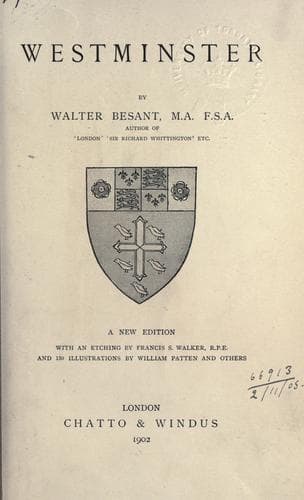
Westminster (London, England) -- Description and travel
Smith Square shows, like so much of Westminster, an odd mixture of old
brick houses, with heavily-tiled roofs, and new brick flats of great
height. In the south-west corner stands the Rectory. Romney and Marsham
Streets were called after Charles Marsham, Earl of Romney. Tufton Street
was named after Sir Richard Tufton. One of the cockpits in Westminster
was here as late as 1815, long after the more fashionable one in St.
James's Park had vanished. The northern part of the street between Great
Peter and Great College Streets was formerly known as Bowling Alley.
Here the notorious Colonel Blood lived.
Near the corner of Little Smith Street stands an architectural museum;
it is not a very large building, but the frontage is rendered
interesting by several statues and reliefs in stone. This, to give it
its full title, is "The Royal Architectural Museum and School of Art in
connection with the Science and Art Department." The gallery is open
free from ten to four daily, and in the rooms opening off its corridors
art classes for students of both sexes are held; the walls are
absolutely covered with ancient fragments of architecture and sculpture.
The row of houses opposite to the museum is doomed to demolition, a
process which has begun already at the north end. The house third from
the south end, a small grocer's shop, is the one in which the great
composer and musician Purcell lived. He was born in Great St. Ann's Lane
near the Almonry, and his mother, as a widow, lived in Tothill Street.
The boy at the very early age of six was admitted to the choir of the
Chapel Royal, and was appointed organist to Westminster Abbey when only
two-and-twenty, a place he very nearly lost by refusing to give up to
the Dean and Chapter the proceeds of letting the seats in the organ-loft
to view the coronation of James II., a windfall he considered as a
perquisite. He is buried beneath the great organ, which had so often
throbbed out his emotions in the sounds in which he had clothed them. On
leaving Tufton Street he went to Marsham Street, where he died in 1695.
The art students from the gallery now patronize the little room behind
the shop for lunch and tea, running across in paint-covered pinafore or
blouse, making the scene veritably Bohemian.
Public-domain text, read in full here on John Shaqi.
Reviews
Reviews
No reviews yet
Be the first to share your thoughts on this work.
Join the Discussion
Join the discussion
Sign in to leave a comment or review.
Sign InorCreate an account