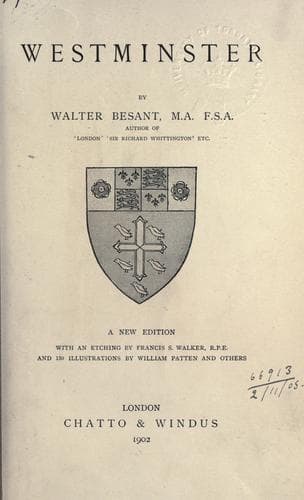
Westminster (London, England) -- Description and travel
Perhaps the most illustrious victim of all those who have perished on
English scaffolds is Sir Walter Raleigh. He was brought out to die in
Old Palace Yard at eight in the morning of October 29, 1618. The day
chosen was Lord Mayor's Day, in the hope that the pageants of the day
would draw away the people from witnessing the death of this great man.
The story of his execution is well known. His last words have not been
allowed to perish. "Now," he said, as he mounted the scaffold, "I am
going to God." Then, touching the axe, he said: "This is a sharp
medicine, but it will cure all diseases." Lady Raleigh herself waited
near the scaffold in a coach. The head was placed in a leather bag,
wrapped about with Sir Walter's gown, and so she carried it away. She
preserved it in a case during the rest of her life, and her son Carew
kept it afterwards. It is believed to have been buried at last at West
Horsley, in Surrey. The body was buried in St. Margaret's, near the
altar.
Here also was imprisoned Colonel Lovelace, who wrote within the gloomy
walls the well-known lines:
"When, linnet-like, confined I
With shriller note shall sing
The mercye, sweetness, majesty,
And glories of my King;
When I shall voyce aloud how good
He is, how great should be,
Th' enlarged winds that curl the flood
Know no such liberty.
"Stone walls do not a prison make,
Nor iron bars a cage:
Minds, innocent and quiet, take
That for an hermitage.
If I have freedom in my love,
And in my soul am free,
Angels alone, that soare above,
Enjoy such liberty."
Here were confined, also, Goodman, Bishop of Gloucester; and Sir Jeffrey
Hudson, the little dwarf, who was first in the service of the Duchess of
Buckingham, and afterwards in that of Queen Henrietta Maria, and was
twice painted by Vandyck. Hudson died in the prison. Hampden, Sir John
Eliot, and Lilly, the astrologer, were imprisoned at various times, and
Titus Oates died in the gatehouse in his sixty-third year. Richard
Savage, the poet, adds another name to the list. In 1776 the Dean and
Chapter of Westminster ordered that the gatehouse should be pulled down,
but one wall, adjoining the house once inhabited by Edmund Burke, was
still standing in 1836.
Close by was Thieving Lane, through which thieves were taken to the
prison without passing by the sanctuary and claiming its immunity.
Within the High Gate was the Abbey Precinct, and with this we pass into
by far the most interesting part of Westminster--that part that may be
called the nucleus, round which cluster so many historical memories that
the mere task of recording them is very great.
PART III
THE HEART OF WESTMINSTER.
Public-domain text, read in full here on John Shaqi.
Reviews
Reviews
No reviews yet
Be the first to share your thoughts on this work.
Join the Discussion
Join the discussion
Sign in to leave a comment or review.
Sign InorCreate an account