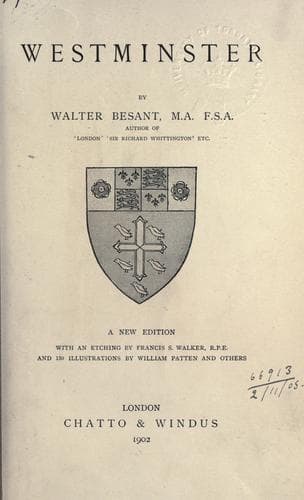
Westminster (London, England) -- Description and travel
At the extreme east end, in the place of the Lady Chapel built by Abbot
Humez, is the famous chapel called the "Wonder of the World," which was
founded and endowed by the first Tudor King, and intended as a place of
sepulture for himself and his family. The foundation-stone was laid in
the presence of Henry VII. himself and of the great builder, Abbot
Islip. The style is Perpendicular, much later than the main portion of
the Abbey, and the whole of the exterior and interior is elaborately
carved and decorated with stone panelling, the badge of the Royal
founder, the Tudor rose, recurring all over the walls. Inside the great
feature is the "fan tracery" of the stone roof, which resembles that of
King's College Chapel, Cambridge. The windows were once filled with
coloured glass, only a fragment of which remains; and the niches with
statues of saints and Kings, many of which were destroyed in early
Puritan times, in the reign of Edward VI. In 1725 this chapel was
appointed as the place for the installation of the Knights of the Bath,
an Order revived by George I., and, although the Knights are now
installed at Windsor, the Dean of Westminster remains the official
chaplain of the Order.
In the centre of the chapel is the tomb of the founder, Henry VII., and
his wife, Elizabeth of York, and on the grille and the gates are the
family badges. The tomb of Henry's mother, Margaret, Countess of
Richmond, is in the south aisle; and the effigies of herself, her son
and his wife, are fine specimens of the skill of the famous Italian
sculptor Torrigiano. Henry's grand-daughters, the Queens Elizabeth and
Mary Tudor, lie in the opposite aisle, sisters parted in life but united
in death. Many other descendants of the founder lie side by side within
the vaults, while the tombs of two of them, Margaret Stuart, Countess of
Lennox, and Mary, Queen of Scots, are close to their common ancestress,
Lady Margaret, in the south aisle. All the Stuart Sovereigns with the
exception of James II. are here, but their only memorials are the wax
figures of Charles II., William and Mary, and Anne, in the Islip chantry
chapel.
In a small chapel to the east of Henry VII.'s tomb once lay the bodies
of the great Protector, Oliver Cromwell, and many of his mighty men, but
their bones were dug up after the Restoration, and not allowed to rest
in the Royal church. The Hanoverian Sovereigns are represented only by
George II. and his Queen, Caroline the Illustrious, who rest here, their
dust mingled according to the King's desire. Close by lie members of
their numerous family and the mother, brothers and sisters of the next
King, their grandson, George III. Amongst his relations is that brave
General, the Duke of Cumberland, whose memory is maligned in the
sobriquet "Billy the Butcher."
Public-domain text, read in full here on John Shaqi.
Reviews
Reviews
No reviews yet
Be the first to share your thoughts on this work.
Join the Discussion
Join the discussion
Sign in to leave a comment or review.
Sign InorCreate an account