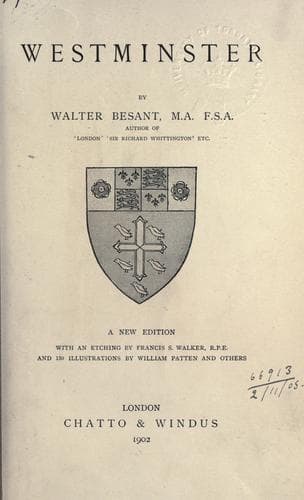
Westminster (London, England) -- Description and travel
It is at present impossible to present a plan of the King's House such
as it was when Edward the Confessor occupied it; we can, however, draw
an incomplete plan of the place later on, say in the fourteenth
century.
The palace was walled, but not moated; it had two principal gates, one
opening to the north, and another on the river. The circuit of the wall
only included twelve acres and a half, and into this compass had to be
crowded in Plantagenet times the King's and Queen's state and private
apartments, and accommodation for an immense army of followers, and also
for all the craftsmen and artificers required by the Court. The total
number of persons thus housed in the fourteenth century is reckoned at
20,000. The part of the King's House thus occupied, the narrow streets
of gabled houses, with tourelles at the corners, and much gilded and
carved work, has vanished completely, even to the memory. When King
Henry VIII. removed to the palace at Whitehall a new Westminster arose
about his old Court; this in its turn almost vanished with the fire of
1834. Up to this time some of the old buildings remained, but have now
completely gone. Among them were the Painted Chamber, the Star Chamber,
the old House of Lords, and Princes' Chamber, all part of Edward the
Confessor's palace. In the Painted Chamber the Confessor himself died,
but it is manifestly impossible to give here any minute account of the
chambers in the ancient building.
The crypt of St. Stephen's Chapel (not shown to visitors) is one of the
few parts remaining which dates from before the fire. The chapel is said
to have been first built by the King whose name it bore, but was
rebuilt by Edward I. and greatly altered by his two immediate
successors. It was used for the sittings of the House of Commons after
Edward VI.'s reign. At the end of the seventeenth century it was much
altered by Wren, but it perished in 1834. A small chapel on the south
side was called Our Lady of the Pew. The oldest part of the ancient
palace remaining is Westminster Hall, built by William Rufus as a part
of a projected new palace. He held his Court here in 1099, and, on
hearing a remark on the vastness of his hall, he declared that it would
be only a bedroom to the palace when finished. However, he himself had
to occupy much narrower quarters before he could carry out his scheme.
Richard II. raised the hall and gave it the splendid hammer-beam roof,
one of the finest feats in carpentry extant. George IV. refaced the
exterior of the hall with stone.
Public-domain text, read in full here on John Shaqi.
Reviews
Reviews
No reviews yet
Be the first to share your thoughts on this work.
Join the Discussion
Join the discussion
Sign in to leave a comment or review.
Sign InorCreate an account