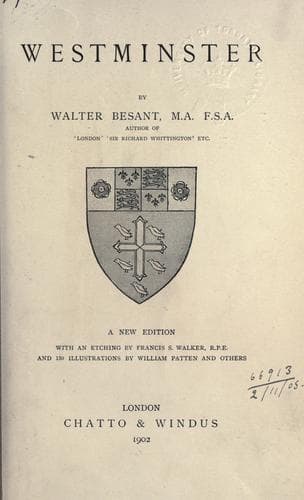
Westminster (London, England) -- Description and travel
Vauxhall Bridge Road was cut through part of the site belonging to the
old Millbank Penitentiary. The traffic to the famous Vauxhall Gardens on
the other side of the river once made this a very crowded thoroughfare;
at present it is extremely dreary. The Scots Guards Hospital is on the
west side.
Turning to the left at the end in the Grosvenor Road, we soon come to
the Tate Gallery of British Art, the magnificent gift of Sir Henry Tate
to the nation. Besides the building, the founder gave sixty-five
pictures to form the nucleus of a collection. This is said to be the
first picture-gallery erected in England complete in itself; the
architect is Sydney Smith, F.R.I.B.A., and the style adopted is a Free
Classic, Roman with Greek feeling in the mouldings and decorations.
There is a fine portico of six Corinthian columns terminating in a
pediment, with the figure of Britannia at the central apex, and the lion
and unicorn at each end. The basement, of rusticated stone, ten feet
high, runs round the principal elevation. A broad flight of steps leads
to the central entrance. The front elevation is about 290 feet in
length. The vestibule immediately within the principal door leads into
an octagonal sculpture hall, top-lighted by a glass dome. There are
besides five picture-galleries, also top-lighted. The pictures, which
include the work of the most famous British artists, are nearly all
labelled with the titles and artists' names, so a catalogue is
superfluous. The collection includes the pictures purchased by the
Chantrey Bequest, also a gift from G. F. Watts, R.A., of twenty-three of
his own works. The gallery is open from ten to six, and on Sundays in
summer after two o'clock. Thursdays and Fridays are students' days.
The gallery stands on the site of the old Millbank Penitentiary, for the
scheme of which Howard the reformer was originally responsible. He was
annoyed by the rejection of the site he advocated, however, and
afterwards withdrew from the project altogether. Wandsworth Fields and
Battersea Rise were both discussed as possible sites, but were
eventually abandoned in favour of Millbank. Jeremy Bentham, who
advocated new methods in the treatment of prisoners, gained a contract
from the Government for the erection and management of the new prison.
He, however, greatly exceeded the terms of his contract, and finally
withdrew, and supervisors were appointed. The prison was a six-rayed
building with a chapel in the centre. Each ray was pentagonal in shape,
and had three towers on its exterior angles. The whole was surrounded by
an octagonal wall overlooking a moat. At the closing of the prison in
Tothill Fields it became the sole Metropolitan prison for females, "just
as," says Major Griffiths, "it was the sole reformatory for promising
criminals, the first receptacle for military prisoners, the great depot
for convicts _en route_ for the antipodes."
Public-domain text, read in full here on John Shaqi.
Reviews
Reviews
No reviews yet
Be the first to share your thoughts on this work.
Join the Discussion
Join the discussion
Sign in to leave a comment or review.
Sign InorCreate an account