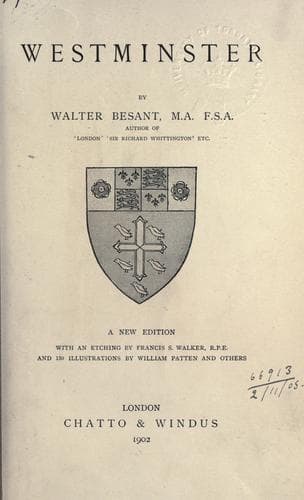
Westminster (London, England) -- Description and travel
Perhaps everything that can be found out about Caxton has been already
discovered. When we consider the antecedent improbability of learning
anything at all about a merchant of the fifteenth century,--not a
merchant of the wealthier kind, neither a Whittington nor a Gresham,--we
may congratulate ourselves upon knowing a good deal about Caxton. To be
sure, he gives us in his prefaces many valuable facts concerning
himself. The learned Mr. William Blades has put together in his two
books on Caxton all that he himself, or that others before him, had been
able to discover. He has also added certain conjectures as to the most
important step in Caxton’s life; I will speak of these conjectures
presently. The result is a tolerably complete biography. We cannot fill
up the life year after year, but in general terms we know how it was
spent and what things were done in the allotted span. That the
personality is shadowy--yet not more shadowy than that of
Shakespeare--cannot be denied.
No one, however, can say, in these times of research, when the documents
of the past are overhauled and made to yield their secrets, that any
point of archæological investigation is finally closed, so that nothing
more will be discovered about it. Somewhere or other are lying hidden
documents, contracts, wills, conveyances, letters, reports,
diaries--which may at any moment yield unexpected treasures to the
finder. Let us remember how Peter Cunningham unearthed the accounts of
the Revels and Masques among the papers of the Audit Office; how the
debates of the House of Commons in the time of Cromwell were discovered;
how Riley’s researches in the archives of London have actually restored
the mediæval city in every detail of its multi-colored life; how the
history of England has been already entirely rewritten during the last
fifty years from newly discovered documents, and must in the next fifty
years be again rewritten. Remembering these things, let us not conclude
that concerning any man, king, statesman, churchman, citizen, the last
word has been spoken, the last discovery made.
For my own part, I have to contribute only those little
discoveries--some may call them theories--which always present
themselves when another man from another point of view approaches a
certain array of facts. That is to say, I have no new fact to announce,
but I have one or two new conclusions to draw.
Let me endeavor, then, to present to you William Caxton as a reality,
not a shadow; you shall see how and why he became, late in life, a
printer; what he was and what was his reputation before he became a
printer. And you shall see for yourselves what kind of book he produced,
how he illustrated it, the kind of type he employed, and the binding of
his books.
First, what manner of man was he, and of what origin?
Public-domain text, read in full here on John Shaqi.
Reviews
Reviews
No reviews yet
Be the first to share your thoughts on this work.
Elsewhere in the archive
Join the Discussion
Join the discussion
Sign in to leave a comment or review.
Sign InorCreate an account