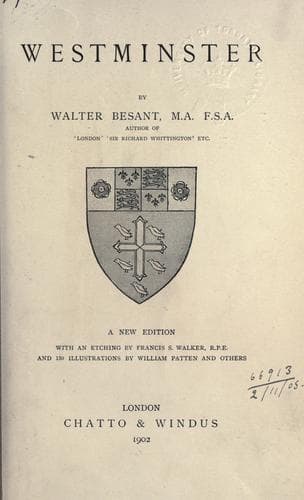
Westminster (London, England) -- Description and travel
About four miles northeast of Tunbridge, in Kent, is the village of
Hadlow, part of which is covered by the manor of Causton. It is
supposed, but it is by no means certain, that from this manor sprang the
family whose name Causton, Cauxton, or Caxton, preserves the memory of
their former holding. Long before the birth of William Caxton the manor,
if the family ever held it, had passed out of their hands. He says,
himself, that he was born in the Weald of Kent. The Weald covers a large
area; but he does not tell us any more, and it is not possible to get
any closer information. In this part of the country he was
born--somewhere. And in this part of the country there is a manor
bearing his name. Can we safely conclude that a territorial name means
that the family were once Lords of the Manor? Certainly not. There is,
however, reason to believe that he came of a City family, and one long
and honorably known in the City; for the name of Caxton or Causton
frequently occurs in the City records. In the year 1303 Aubin de
Caustone, haberdasher, was appointed one of a committee to make scrutiny
into the manufacture of caps by methods and of materials forbidden by
law. In 1307 William de Causton is one of those who sign a letter
addressed to the Bishop of Chester by the City Fathers. In 1327 John de
Causton, Alderman, is one of a Board of Arbitrators between certain
disputing trade companies; and he represented the city at the council of
Northampton in 1337, for which service he received the sum of sixty
pounds. In 1331 John de Caxton and Thomas de Caxton were butchers--the
latter, one regrets to find, obstructing the street with his stall at
the Poultry, for which his meat was forfeited. In 1334 William de
Causton, living in the parish of St. Vedast, was an Alderman. In the
year 1348 there were seven of the name who paid their fees as liverymen
of the Mercers’ Company. In 1364 Alice, wife of Robert de Causton, who
appears to have been a vintner, was sentenced to the “thewe,” for
thickening the bottom of a quart pot with pitch, so that he who ordered
a quart of wine got short measure. This deplorable incident is the only
one which tarnishes the honor of the Caustons or Caxtons. In 1401
William de Causton is apprenticed to Thomas Gedeney. In 1414 John
Causton is a butcher. In 1424 Stevyn Causton is a liveryman of the
Mercers. The family of Causton or Caxton, therefore, were largely
engaged in various branches of trade in London during the whole of the
fourteenth century. Whether William Caxton’s father was himself a
citizen and freeman, and if so, how the son came to be born in the Weald
of Kent, is not known. As the boy was apprenticed to the very richest
merchant in the city, and admitted a member of the wealthiest company,
it is quite certain that his people were of some consideration in the
city: to be received into the house of a great merchant as an
apprentice, to be admitted into the Company of Mercers, proves beyond a
Public-domain text, read in full here on John Shaqi.
Reviews
Reviews
No reviews yet
Be the first to share your thoughts on this work.
Elsewhere in the archive
Join the Discussion
Join the discussion
Sign in to leave a comment or review.
Sign InorCreate an account