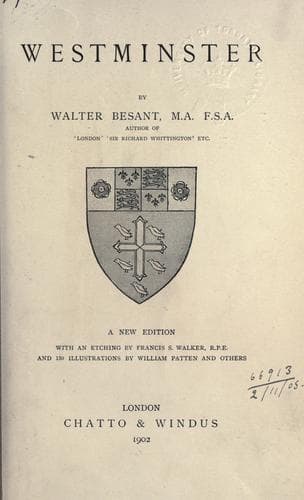
Westminster (London, England) -- Description and travel
As to the books themselves, Caxton, in the true spirit of trade, gave
the world not what he himself may have wanted, but what the world
wanted. Books of romance, chivalry, and great achievements were demanded
by the knights and nobles. Books of service were wanted by the Church.
Caxton provided these. These things illustrate the character of the
man--cautious, businesslike, anxious to run his press at a profit, so
that he tried no experiments, and was content to be a servant rather
than a teacher.
Those who will take the trouble to visit the British Museum and there
examine for themselves the treasures which the nation possesses of early
printing--the case full of Caxtons in the King’s Library, the shelf
filled with Caxtons in the vast Library, which the general visitor is
not allowed to see--will be astonished to observe the rapid advances
already made in the Art of Printing when Caxton undertook its practice.
Printing was first invented some time in the first half of the fifteenth
century.[6] The type is clear and strong--clearer type we have never
made since; the
[Illustration: CAXTON MEMORIAL WINDOW IN ST. MARGARET’S, WESTMINSTER.]
ink is perfectly black to this day; the lines are even and in perfect
order; the binding, when an ancient binding has been preserved, is like
any binding of later times. But the shape of the book was not newly
invented, nor the binding, nor the form of the type; in these matters
the printer followed the copyist. In the earlier examples the
illuminator was called in to adorn the book, copy by copy, with his
art-initials, colored letters, pictures delicately and beautifully
drawn, colored and gilt in the printed page. The illuminator, however,
very soon gave way to the engraver. The wood engravings of the late
fifteenth century, rough though they are, and coarse in drawing and
outline, are yet vigorous and direct; they illustrate what they desire
to illustrate. One can believe that those who could afford the
illuminations continued to order and to buy the manuscripts, for the
sake of their delicacy and beauty. But the printed book, with its rough
engraving, was within the reach of student, priest, and squire, to whose
slender means the illuminated work was forbidden.
[Illustration: FACSIMILE OF CAXTON’S HANDWRITING, FROM THE PEPYSIAN
LIBRARY.]
Public-domain text, read in full here on John Shaqi.
Reviews
Reviews
No reviews yet
Be the first to share your thoughts on this work.
Elsewhere in the archive
Join the Discussion
Join the discussion
Sign in to leave a comment or review.
Sign InorCreate an account