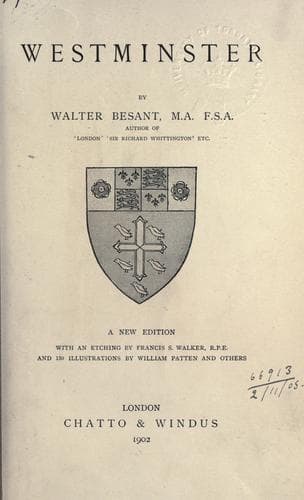
Westminster (London, England) -- Description and travel
The more one considers this figure of the fifteenth-century workman, the
more clearly he stands out before us, grave, anxious, resolute of
face--the more he becomes admirable and wonderful. For thirty years
engaged in protecting English interests in the Netherlands--patient,
tenacious, conciliatory; the friend and servant of the most powerful
lady in Europe; the friend of all those at home who regarded literature;
himself a lover of poetry and of romance, and at the mature age of
sixty-five engaged in translating the latter; a good linguist; a good
scholar; and, most certainly, one who could look into the future, and
could foretell something of the influence which the press was destined
to have upon the world. And all this in a simple liveryman of the
Mercers’ Company, without education other than that enjoyed by all lads
of his position, without wealth and without family influence other than
that derived from the long connection with the City in various trades of
his kith and kin. Admirable and wonderful is the life of this great man;
admirable and wonderful are his achievements.
He died in harness. Thus sayeth Wynkyn de Worde in the “Vitæ Patrum”:
“Thus endyth the most vertuouse hystorye of the devoute and righte
renowned lyves of holy faders lyuynge in deserte, worthy of remembrance
to all wel dysposed persons, which hath ben translated oute of French
into English by William Caxton of Westmynstre late deed and fynyshed at
the laste daye of hys lyff.” He died in the year 1491, and was buried at
St. Margaret’s, where his wife, Maude, and perhaps his father, were also
buried. He left one child, a daughter. He left a will, which is lost;
but one clause was a bequest of fifteen copies of the “Golden Legend” to
the parish church. These were afterward sold at prices varying from 5s.
4d. to 6s. 8d. If money was then worth eight times its present value, we
can understand that books, although they were greatly cheapened by
being printed instead of written, had not yet become cheap.
Many of the books which he published were romances, as has been said,
and tales of chivalry. He loved these tales himself, as much as the
noble ladies and gallant knights for whom he published them. Let us end
this notice with his own words on the excellence and the usefulness of
romance. He is speaking of the “History of King Blanchardine and Queen
Eglantine his Wife,” translated by order of the Lady Margaret:
Public-domain text, read in full here on John Shaqi.
Reviews
Reviews
No reviews yet
Be the first to share your thoughts on this work.
Elsewhere in the archive
Join the Discussion
Join the discussion
Sign in to leave a comment or review.
Sign InorCreate an account