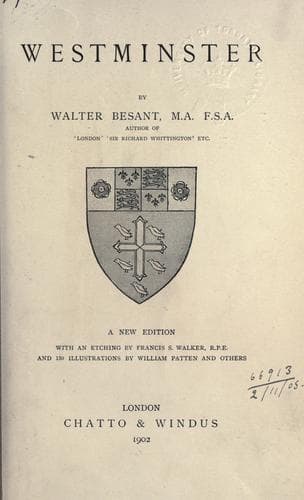
Westminster (London, England) -- Description and travel
Beyond the Banqueting Hall and the Gate House there is a broad street,
now Parliament Street, then a portion of the Palace. On the other side,
where in King Henry’s reign were the Tilt Yard and the Cockpit, are the
old Horse Guards and Wallingford House, afterward the Admiralty. Beyond
these buildings is St. James’s Park, with fine broad roads, which remain
to the present day; on the left is Rosamond’s Pond in its setting of
trees, to which reference is constantly made in the literature of the
seventeenth century.
At the south end of the open space stood the beautiful gate erected by
Holbein. It was removed in 1759.
The appearance of the Palace from the river has been preserved in
several views, in none of which do the details all agree. The one
produced here is taken from Wilkinson’s “Londina Illustrata,” and shows
the Palace in the time of James II. The general aspect of
[Illustration: ST. JAMES’S PALACE.]
the Palace is that of a great collection of chambers and offices built
as they were required, for convenience and comfort, rather than for
beauty or picturesqueness. There are no towers, cloisters, gables, or
carved work. It is essentially--like St. James’s, like Hampton--a palace
of brick.
The greater part of Whitehall Palace was destroyed by fire in 1691 and
1697. After the deposition of James II. it ceased to be a royal
residence. Then the site of the Palace was gradually built over by
private persons. The Banqueting Hall was for a long time a Chapel Royal;
it has now become the house for the collections of the United Service
Institute. One could wish that some of the Palace had been preserved:
from the marriage of Anne Boleyn to the deposition of James II. is a
period which contains a great many events of interest and importance,
all of which are associated with this Palace. The destruction of the
ancient Faith, the dissolution of the Religious Houses, the re-birth of
Classical learning, the vast development of trade, the widening of the
world, the beginning of the Empire _outre mer_, the humbling of Spain,
the successful resistance of the nation against the king, the growth of
a most glorious literature, the revival of the national spirit--all
these things belong to Whitehall Palace. Other memories it had, not so
pleasing: the self-will of Henry, the misery of his elder daughter, the
execution of Charles I., the licentious Court of Charles II.--one wishes
that the place had been spared.
Public-domain text, read in full here on John Shaqi.
Reviews
Reviews
No reviews yet
Be the first to share your thoughts on this work.
Elsewhere in the archive
Join the Discussion
Join the discussion
Sign in to leave a comment or review.
Sign InorCreate an account