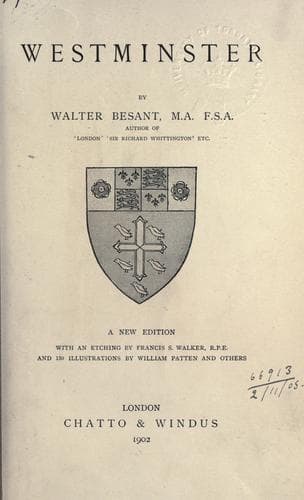
Westminster (London, England) -- Description and travel
We have copied the plan of the Palace. It is, however, impossible to
fill in the plan with the innumerable offices, private rooms, galleries,
and chambers mentioned by one writer and another. We must be content to
know that it was a vast nest of chambers and offices; there were
hundreds of them; the courts were crowded with people; there was a
common thoroughfare through the middle of the Palace from Charing Cross
to Westminster; so many funerals, for instance, were conducted along
this road to St. Margaret’s, that Henry VIII. constructed a new burial
ground at St. Martin’s. The Palace was accessible to all; the Guard
stood at the gate, but everybody was admitted as to a town; the King
moved freely about the Courts, in the Mall, in the Park, sometimes
unattended. The people drove their pack horses or their wagons up and
down the road, and hardly noticed the swarthy-faced man who stood under
the shade of a tree watching the players along the Mall. This easy and
fearless familiarity vanished with the Stuarts.
[Illustration: KENSINGTON PALACE.]
Between this palace and that of Westminster there were certain important
points of difference. One, the absence of the law courts, has already
been noticed. At Whitehall there was a Guard House; it stood, as has
been said, in Scotland Yard; no doubt the Gate was guarded; in 1641 the
old “Horse Guards” was built for the Gentlemen Pensioners who formed the
Guard; but there was no wall round the Palace, there was no suggestion
of a fortress, there was no suggestion of a camp. Next, the Palace of
Westminster was always, as had been intended by Edward the Confessor,
connected with the Abbey. It had, to be sure, its own chapel--that of
St. Stephen’s; but it was connected by historical associations of every
kind with the Abbey. The ringing of the Abbey bells, the rolling of the
organ, the chanting of the monks could be heard by day and by night
above the music and the minstrelsy, the blare of trumpet and the clash
of arms. At Whitehall there was a chapel, but the Abbey was out of
hearing. When Henry removed his Palace from Thorney Island to York
House, it was a warning or a sign that he would shortly remove himself
from the domination of the Church.
[Illustration: BUCKINGHAM PALACE.]
As for the Court in the reigns of Elizabeth and James, we have full
details. The Yeomen of the Guard, who were the bodyguard, wore red cloth
roses on back and breast. When the Court moved from
[Illustration: THE HORSE GUARDS.]
Public-domain text, read in full here on John Shaqi.
Reviews
Reviews
No reviews yet
Be the first to share your thoughts on this work.
Elsewhere in the archive
Join the Discussion
Join the discussion
Sign in to leave a comment or review.
Sign InorCreate an account