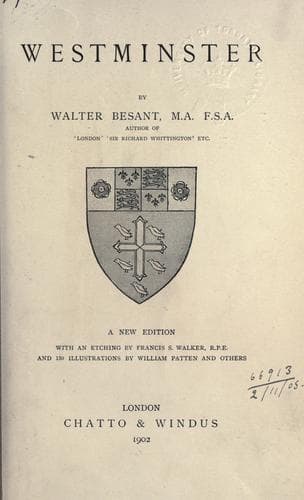
Westminster (London, England) -- Description and travel
The Houses of Parliament--their history, their buildings, their
constitution--belong to the history of the Empire. They happen to stand
in the City of Westminster; but their history does not form part of the
City history. The House of Commons has been called to Westminster almost
without interruption for six hundred years. It sat for three hundred
years in the Chapter House of the Abbey; then for three hundred years
more in the Chapel of St. Stephen; when that was burned down the site
was preserved and set apart for the New House, which arose when the
ashes of the old had been cleared away. That site must not be considered
a part of Westminster; it is part of the Island--part of the Empire.
[Illustration]
In a certain special sense, however, the House of Commons did belong to
the City of Westminster for a long time. A great many of the country
members lodged in the narrow streets round the Abbey. The reason is
plain: there were no streets or houses in the meadows lying north and
west of the Houses of Parliament; either the members must lodge in the
City of London and take boat for St. Stephen’s, or they must lodge in
Westminster itself. It is stated by a writer of the last century that
the principal means of support for the people of Westminster were the
lodging and entertainment of the members. The monks were gone; Sanctuary
was gone; the Court was gone; but the members remained, and so the
taverns remained, too, and the ancient reputation of Westminster as a
thirsty city was happily uninjured.
In another way Westminster created for itself a new distinction. As a
borough it became notorious for the turbulence and the violence of the
elections. Its central position, the King’s House always lying within
its boundaries, the City of London its near neighbor, naturally caused
an election at Westminster to attract more attention than an election at
Oxford, say, or Winchester. Again, the electors of Westminster were not,
probably, fiercer partisans than those of any other place, nor were
their candidates always of greater importance; yet it is certain that
for downright bludgeon rowdiness and riot, the rabble at Westminster,
when it turned out at election time, was equaled by few towns, and
surpassed by none.
Public-domain text, read in full here on John Shaqi.
Reviews
Reviews
No reviews yet
Be the first to share your thoughts on this work.
Elsewhere in the archive
Join the Discussion
Join the discussion
Sign in to leave a comment or review.
Sign InorCreate an account