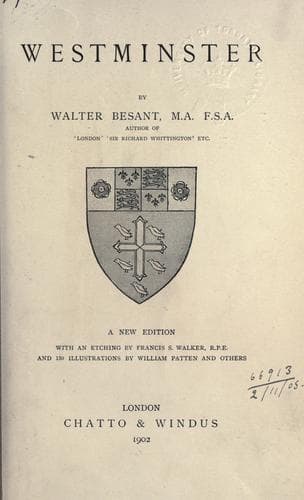
Westminster (London, England) -- Description and travel
“Love’s common wealth consists of toys:
His council are those antic boys.
Games, laughter, sports, delights,
That triumph with him on these nights,
To whom we must give way,
For now their reign begins and lasts till day.
They sweeten Hymen’s war,
And, in that jar,
Make all, that married be,
Perfection see.
Shine, Hesperus, shine forth, thou wishèd star!”
The Masque was short-lived. It was stately and dignified; it was
courtly; it was classical; it was serious; nobody laughed much, except
perhaps at the “antic” dances which were sometimes introduced. It
required fine, if not the finest, poetic work. It could not be
adequately presented without lavish expenditure. It demanded the
performance of amateurs. When the troubles of the next reign began
there was little desire for such entertainments, and no money to spare
for the production of a Masque on the old scale of splendor. When
Charles II. returned all the world wanted to laugh and to sing; the
Masque, slow and stately, was out of fashion. Charles made an attempt to
revive it, but without success. It was quite forgotten; the old
properties were stowed away and molded in the cellars till the fire came
and burned them all. And the stage effects, the sudden changes of scene,
the clouds and the rocks and streams were all forgotten, until they were
revived in the present century.
There are many memories of Whitehall on which we might enlarge; scenes
in the later life of Henry VIII.; scenes in the Court of Queen Mary;
tilts, feasts, and entertainments by Queen Elizabeth; the death of
Charles; the occupation by Cromwell; the mistresses of Charles the
Deplorable--with a great many more. These, however, belong to the things
already narrated. I have endeavored to recall certain associations which
have hitherto belonged to the Book of the Things Left Out; and among
them there are none so pleasing and so characteristic as the Masque in
the reign of James I.
Now there is nothing left of Elizabeth’s Palace at all; of Charles’s
Palace, only the latest and last construction, the Banqueting Hall. When
the fires of 1691 and 1697 swept all away except this building, there
perished a collection of courts and houses for the most part dingy,
without the picturesque appearance of the old Palace, which, if it was
crowded and huddled together, was full of lovely mediæval towers,
gables, and carved work. Whitehall as a building was without dignity and
without nobility. Yet one wishes that it had remained to the present
day. Hampton Court, as I have said above, remains to show the world what
Whitehall Palace was like.
William III. talked of rebuilding the place; but he died. Queen Anne
took up her residence in St. James’s. And Whitehall Palace vanished.
CHAPTER IX.
THE CITY.
Public-domain text, read in full here on John Shaqi.
Reviews
Reviews
No reviews yet
Be the first to share your thoughts on this work.
Elsewhere in the archive
Join the Discussion
Join the discussion
Sign in to leave a comment or review.
Sign InorCreate an account