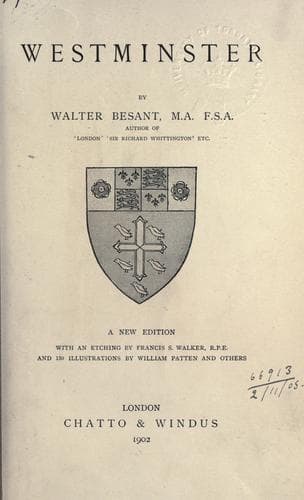
Westminster (London, England) -- Description and travel
New Palace Yard was formerly an inclosed area, surrounded by buildings
picturesquely grouped. I do not think we have anything to show more
picturesque than New Palace Yard in the fifteenth century. On the North
side stood the Clock Tower, just where Parliament Street now begins. It
was a very handsome Clock Tower, erected against his will by Chief
Justice Ralph Hingham in the reign of Edward I. He was amerced in the
sum of eight hundred marks for altering a court roll in favor of a poor
man. His charity cost him dear. There was a warden of the Clochier, and
the bell, called Tom, was the heaviest in London. In the year 1698 the
Clock Tower was given to the Vestry of St. Margaret’s. They proceeded to
pull it down--one knows not why. The materials were sold for £200; the
bell for £385 17s. 6d.; it weighed 82 cwt. 2 qrs. 21 lbs. The bell was
recast and taken to St. Paul’s.
On either side of the Clock Tower ran houses
[Illustration]
belonging to the merchants of the Wool Staple, the market place of which
was at the back of the houses; an archway opened into King Street at the
northwest corner; the west side was occupied by houses, the gate into
the Abbey, and St. Margaret’s; on the south side was Westminster Hall,
with the Courts of the Exchequer; on the east was the Star Chamber,
ending in what was called the Bridge, and a pier running out into the
river. Under the Courts of the Exchequer were two prisons called “Hell,”
and “Purgatory.” There was also “Heaven,” and all these places became
taverns.
When one speaks of Westminster Hall it seems as if the whole of English
history rolls through that ancient and venerable building. Historians
have exhausted their eloquence in speaking of these gray old walls. What
things have they not seen? The coronation banquets; the entertainments
of kings; the proclamations; the solemn oaths; the State trials; we
cannot, if we would, keep out of Westminster Hall. It was once the High
Court of Justice: three Judges sat here in different parts of the Hall,
hearing as many cases.
The State trials may be left to Macaulay and the historians. I think
that we are here most concerned in that curious trial of the ‘prentices
which followed “Evil May Day,” 1547.
Everybody knows that the Church of St. Andrew Undershaft is so called
because a tall May-pole, the highest in London, was laid along, under a
pentice, the side of the church and a row of houses called Shaft Alley.
Every May Day the pole was taken off its iron hooks and set up on the
south side of the church in the street, being higher than the steeple
itself. Now, as to the connection of the steeple with Westminster Hall,
it shall be told in the words of Maitland:
Public-domain text, read in full here on John Shaqi.
Reviews
Reviews
No reviews yet
Be the first to share your thoughts on this work.
Join the Discussion
Join the discussion
Sign in to leave a comment or review.
Sign InorCreate an account