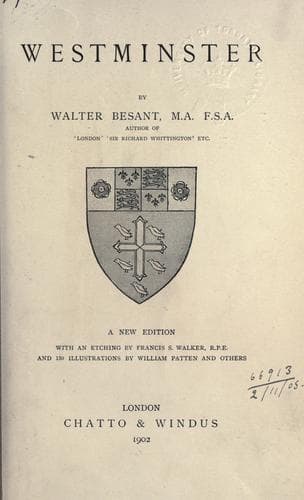
Westminster (London, England) -- Description and travel
This multiplication of rules, this attention to trifles, these childish
diversions, prove, if any proof were wanted, the deadly dullness of the
monastic life, unless it was lit up by spiritual fervor. The ordinary
mind cannot dwell continually upon things spiritual, yet it must be
occupied with something; therefore, when the monks were not engaged in
services or in the Refectory, although they were ordered to work at some
bodily or intellectual pursuit, most of them occupied themselves with
trifles; they amused themselves with childish shows; they admonished and
corrected each other with boyish discipline. We need not ask why
Westminster produced no great scholars: it was not the real business of
the Abbey to produce scholars, but to sanctify the life of the monk, and
to sing so many services a day for the good of the Brethren first and of
those outside afterward. Now comes the question, How much of the Rule
was obeyed in the latter days, just before the Dissolution? The
discipline varied from House to House. It is very certain that the
Carthusian Rule was strictly observed at the Charter House, and that
[Illustration: A PILLAR NOW STANDING IN MR. THYNNE’S GARDEN AND FORMING
PART OF THE RUINED CHAPEL OF ST. CATHERINE.]
the Benedictine Rule was observed with laxity at the Priory of the Holy
Trinity. Chaucer’s jolly monk has horses in the stable; he can go abroad
as he pleases; he is not dressed as a monk. Again, there is one of the
stories concerning Long Meg of Westminster which seems to show that the
monks went about in the taverns outside the Abbey. Yet the holding of
certain offices gave permission to go outside the Abbey.
[Illustration: JERUSALEM CHAMBER, ABBOT’S RESIDENCE, WESTMINSTER.]
There is every kind of evidence to prove that luxury and pride and
laziness had become a common charge against the monks long before the
Dissolution. Was there a voice or a hand raised in London or Westminster
to save the Houses? Why, had there been even a small minority in London
by whom the Houses were respected, Henry had not dared to touch them. He
beheaded those who opposed his will. True, the great nobles he beheaded,
but not the crowd, who, had they cared for the Houses, could have
defended them against all the power of the King. But the scanty memoir
of Hugh de Steyninge, which has been collected painfully from various
sources, does not enable me to state with any exactness how far the Rule
was still observed.
Public-domain text, read in full here on John Shaqi.
Reviews
Reviews
No reviews yet
Be the first to share your thoughts on this work.
Join the Discussion
Join the discussion
Sign in to leave a comment or review.
Sign InorCreate an account