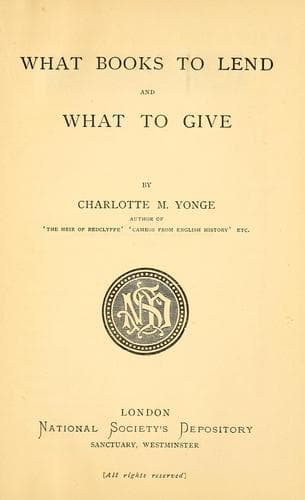
What books to lend and what to giveYonge, Charlotte M. (Charlotte Mary)
General
What books to lend and what to give
Yonge, Charlotte M. (Charlotte Mary)
Books and reading -- Great Britain; Children's literature -- Bibliography
It has, however, been thought better not to enter upon the tracts and
sermons, such as a parish priest or district visitor would give for
private use or specific purpose, as they are devotional, and scarcely to
be spread broad-cast by the Library. Every librarian must cater for his
own clients according to their tastes and needs. No doubt much is here
left out that will be found useful in some places, but the attempt has
been made to offer suggestions, and to collect, from various quarters,
names that may serve to assist in the selection of books for the various
needs of a parish.
[Illustration]
[Illustration]
LITTLE ONES.
The books in the following list are what have been read to
children from five or six to eight years old and proved to be
interesting to them. Their eyes and attention soon show whether
the book is liked. And, though it may hardly be believed, it
is more difficult to write a story suited to them than to any
other class, since it must be perfectly easy and simple, and
yet have some interest in it, such as they can understand.
Stories that are in fact a study of children with peculiar
ways and odd sayings are of no use. The tale must take the
child’s point of view, yet without obviously writing _down_
to its level, and any moral must be pointed as tersely and
briefly as possible. Unluckily several of those I have found
most successful have gone out of print—namely, ‘The White
Kitten,’ and ‘Out in the Dark,’ in early packets of the books
Mr. Burns used to publish, and ‘Little Lucy’ and ‘A Tale of
a Tail’ (S.P.C.K.). I have looked over multitudes of tiny
books, but only a few have the special charm that will keep
a whole class devouring the reader with their eyes, and be
welcomed even if read over and over again. I have not here
mentioned Mrs. Ewing’s beautiful series of verse-books for
children, with their charming illustrations, because they are
really studies of childhood, and more fit for the drawing-room
than the cottage or school. The same may be said of the very
pretty Everyday Fables, the letterpress of which is quite
beyond little children. The best thing for the youngest class
of four, five, or six years old, is the ‘Child’s own Picture
Paper’ (Dean), Aunt Louisa’s books (Warne), and the ‘Child’s
Illustrated Scripture History’ (S.P.C.K.), 4 parts, price 1_s._
each. Or, if the class be too large for showing them pictures
in a book, detached ones on an easel are useful. One or two
sacred ones, well explained, are enough, and a few secular
ones may follow. Let me hint that undraped figures, shown to
poor children, are undesirable, and that if there is a mistake
in the accessories, by some fatality, they are sure to admire
it. Cassell’s ‘Little Pet’s Posy,’ 1_s._ 6_d._, or ‘Little
Chimes,’ 1_s._ 6_d._, will give amusing bits to read to the
Public-domain text, read in full here on John Shaqi.
Reviews
Reviews
No reviews yet
Be the first to share your thoughts on this work.
Join the Discussion
Join the discussion
Sign in to leave a comment or review.
Sign InorCreate an account